
You’re grinding through your squat sessions, but something feels off. Maybe your heels lift at the bottom, or your torso pitches forward no matter how hard you brace. Before you blame your hips or your core, take a closer look at your ankles. Limited ankle dorsiflexion is one of the most common culprits behind a broken squat pattern, and there is one warning sign that often appears before everything else falls apart.
That sign is a subtle but consistent early heel lift as you descend below parallel. If the front of your ankle — the talocrural joint — lacks the range of motion to let your shin travel forward enough, your body instinctively shifts your weight to the balls of your feet. The heel comes up, your center of gravity shifts forward, and your squat becomes a different — and less stable — movement entirely.
Why ankle mobility matters more than you think for squatting
In a well-executed squat, your shin needs to move forward over your foot by roughly 10 to 15 degrees of dorsiflexion. That shin travel allows your hips to drop between your ankles, keeps your torso upright, and maintains a full foot connection with the floor. When your ankle joint is stiff — whether from old injuries, tight calves, or simply wearing heels or stiff shoes daily — that forward shin angle becomes impossible without compensation.
The result is a chain reaction: your heels lift, your weight shifts to your toes, your hips shoot back to counterbalance, and your lower back rounds trying to keep the bar path vertical. That is why many lifters who think they have a "butt wink" problem or a "hip impingement" issue actually have an ankle mobility problem that is driving the entire faulty pattern.
Spotting the warning sign: the heel lift test
You do not need a coach or a goniometer to check for this. Set up for a goblet squat or a bodyweight squat next to a wall. Squat down to a comfortable depth, and then try to lift all ten toes off the ground while keeping your heels planted. If your heels pop up when you lift your toes — or if you can not keep them down even with your toes flat — you likely have limited dorsiflexion. Another practical test is simply filming a set of squats from the side. Watch your feet in slow motion. If your heel breaks contact with the ground at the bottom, that is your warning sign.
One subtle cue to watch for: If your knees travel significantly forward on the descent but then suddenly stop and shift backward at the bottom, your ankle range is maxing out and forcing a compensatory movement.
What causes ankle stiffness in the first place?
Ankle stiffness is not just a squat problem; it is often a lifestyle problem that surfaces in the gym. Common contributors include:
- Past ankle sprains or fractures — scar tissue and altered joint mechanics can restrict motion for years after the initial injury.
- Chronic tightness in the soleus and gastrocnemius — the calf muscles that cross the ankle joint and limit dorsiflexion when they are overactive or shortened.
- Shoe wear patterns — running shoes with elevated heels and stiff soles, or wearing heels regularly, adapts the ankle to a plantarflexed position.
- Prolonged sitting — tight hip flexors are often discussed, but a sedentary position also shortens the posterior chain and stiffens ankle connective tissue.
Practical ways to improve squat depth by releasing the ankles
If you have identified the warning sign of early heel lift, you can address it without drastic changes to your squat form. These are not medical prescriptions, but general mobility approaches you can integrate into your warm-up.
1. Ankle mobilizations with a band or a weight
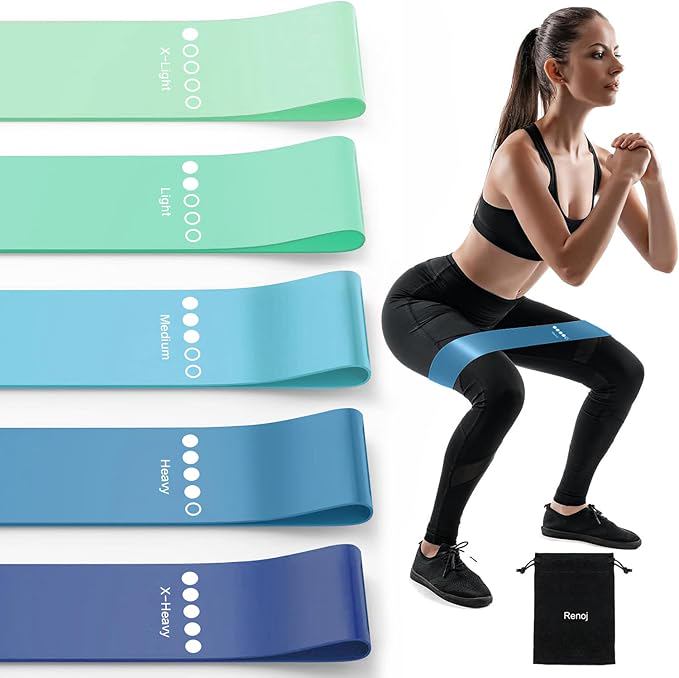
Loop a heavy resistance band around a stable anchor at ankle height. Place the band over the front of your ankle joint (the talus bone). Step into a half-kneeling position with the banded ankle forward. Keeping your heel planted, drive your knee forward over your toes until you feel a stretch in the front of the ankle and the back of the calf. Hold for 2 seconds, return, repeat for 10 reps per side.
2. Calf Stretching on a slant
Use a slant board or a wedge (or even a thick book with a towel) to stretch both the gastrocnemius (straight knee) and soleus (bent knee) independently. Hold each stretch for 30 to 45 seconds, focusing on staying relaxed. This directly addresses the tissue tension that limits dorsiflexion.
3. Tibialis anterior activation
The muscle on the front of your shin — the tibialis anterior — also plays a role in controlling the descent. Toe raises (lifting the toes while keeping the heel down) performed in a seated or standing position can improve the neuromuscular control needed to hold the heel down under load.
Tip: Perform these drills before your squat warm-up sets, not just on recovery days. Even 5 minutes of ankle prep can change how your squat feels that session.
When the warning sign is the only thing holding your squat back
It is common for lifters to fix a heel lift issue and suddenly find an extra two inches of squat depth, a more upright torso, and less lower back fatigue. The ankle is the often-overlooked foundation of the squat. If you have been struggling with rounding, tipping forward, or knee pain without a clear cause, check your heel contact first. That one warning sign — the early heel lift — might be the only thing standing between you and a stronger, safer squat.