
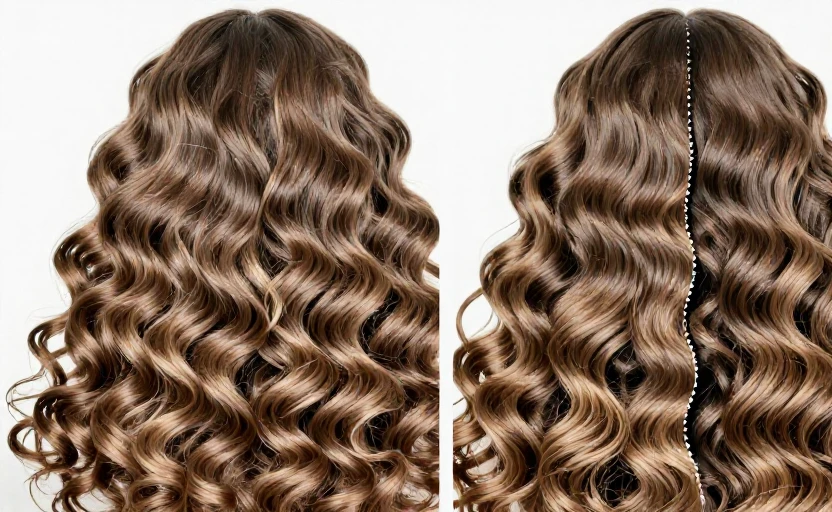
If you have curly hair, you know the feeling: you’re gently detangling a curl, and you see it—a tiny, frayed split at the end, a sign your hair is literally breaking apart. For curls, split ends aren't just an aesthetic nuisance; they can travel up the hair shaft, causing frizz, tangles, and making your defined ringlets lose their shape. The good news is that this damage is largely preventable. The secret lies in understanding and managing two fundamental building blocks of hair health: protein and moisture.
Think of a single strand of curly hair as a delicate rope. The outer layer, or cuticle, is made of overlapping scales that protect the inner core, the cortex. The cortex is where the magic happens—it's packed with keratin proteins and bonds that give hair its strength and elasticity, and it holds onto the water that keeps it supple. Curly hair, with its twists and turns, has points along its length where these protective cuticle scales don't lie as flat. This makes the inner cortex more vulnerable to everyday stressors like brushing, heat styling, and environmental exposure. When the protein structure weakens or the hair becomes too dry, that inner core starts to fracture, leading to the dreaded split end.
The Role of Protein: Your Hair's Reinforcement
Protein is the structural foundation of your hair. Keratin, a fibrous protein, makes up the majority of the hair shaft, forming long chains that provide strength and resilience. For curly hair, which is naturally more fragile due to its structure, maintaining this protein integrity is non-negotiable.
When hair is damaged—from color processing, high heat, or even just mechanical stress from rough drying—it creates gaps in the protein structure. Think of it like a brick wall losing mortar. The hair becomes weak, porous, and prone to snapping. This is where split ends begin. Using protein treatments, often called reconstructors or bond builders, helps to temporarily fill those gaps. They don't permanently "repair" hair, but they reinforce it from the inside out, patching the weak spots and helping to prevent further breakage that leads to splits.
A good rule of thumb: If your hair feels overly stretchy, mushy when wet, or lacks bounce, it may be asking for a protein boost.
The Role of Moisture: Your Hair's Flexibility
If protein is the brick and mortar, moisture is the element that keeps everything pliable. Hair needs a certain amount of water content to maintain its elasticity—its ability to stretch and return to its original shape without breaking. Curly hair, because of its shape, has a harder time naturally distributing its own oils from root to tip, making the ends particularly susceptible to dryness.
When hair is dehydrated, it becomes brittle. Brittle hair has no give; it snaps easily under tension. This lack of flexibility is a direct path to split ends. Moisturizing ingredients like humectants (e.g., glycerin, honey) and emollients (e.g., plant butters, oils) work to attract water to the hair and seal it in, keeping the cortex hydrated and the cuticle smooth. This suppleness allows curls to clump, move, and resist breaking when you style or detangle.
If your curls feel straw-like, excessively frizzy, or make a crunchy sound when touched, they are likely crying out for moisture.
How Protein and Moisture Work as a Team
The prevention of split ends isn't about choosing one over the other; it's about balance. This is often called "hair homeostasis." Imagine a scale. Too much protein without enough moisture leads to hair that is strong but rigid and brittle—it will eventually snap. Too much moisture without enough protein leads to hair that is soft but weak and overly stretchy—it will eventually break under its own weight.
For curly hair, the goal is to find the sweet spot where the hair is both strong and flexible. A balanced routine might involve a moisturizing conditioner at every wash, paired with a protein treatment every few weeks or as needed based on your hair's signals. Deep conditioning treatments often contain a blend of both moisturizing and light protein ingredients, making them a great maintenance tool.
A Practical Routine to Fortify Your Ends
Preventing split ends is a proactive game. Incorporate these habits to support your hair's protein-moisture balance from the outside.
- Pre-wash protection: Before shampooing, apply a light oil or conditioner to your ends. This creates a buffer, preventing them from becoming too dry and swollen during the wash, which can stress the cuticle.
- Gentle cleansing: Use a sulfate-free shampoo focused on your scalp. Let the suds run down the length of your hair to clean it, avoiding rough scrubbing on the ends themselves.
- Strategic conditioning: After washing, apply a moisturizing conditioner from mid-lengths to ends. Use a wide-tooth comb to detangle gently while the conditioner is in, starting from the tips and working upward to minimize stress.
- Seal in hydration: On damp hair, apply a leave-in conditioner followed by a styling cream or gel. For an extra seal on the driest ends, a tiny drop of a light oil like argan or jojoba can lock in moisture without weighing hair down.
- Low-manipulation styling: Reduce daily brushing and combing. Style hair while it's wet and loaded with product, then allow it to air-dry or use a diffuser on low heat. Sleep on a silk or satin pillowcase to reduce friction.
Ultimately, the most effective way to deal with a split end is to trim it off. No product can fuse the hair shaft back together permanently. However, by consistently supporting your hair's protein and moisture needs, you dramatically reduce how often those splits occur, allowing your curls to grow longer, healthier, and stronger from root to tip.