
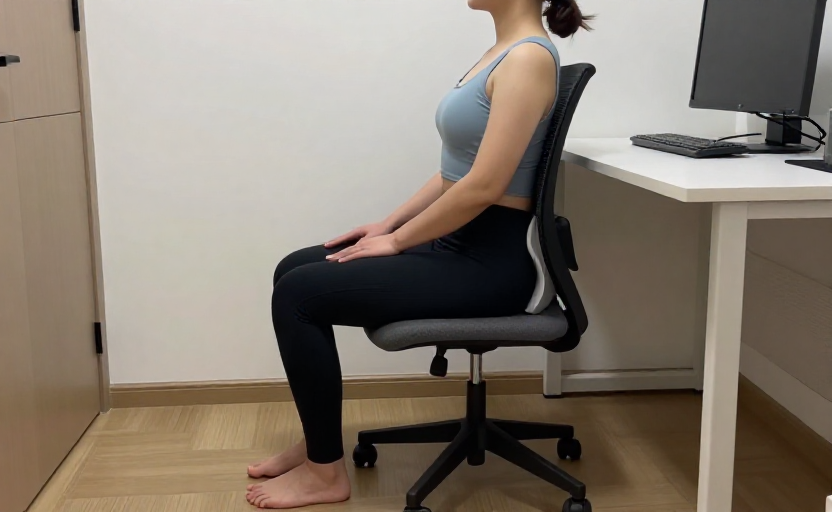
Back pain often creeps up from the small, repeated positions we hold throughout the day—slouching at a desk, tilting a head toward a phone, or standing with a locked hip. Physical therapists emphasize that the spine responds best to consistent, low-effort alignment corrections rather than occasional heroic stretches. The following five posture habits, grounded in biomechanics and clinical practice, target the daily patterns that most commonly strain the lower back.
1. Reset your sitting foundation every 20 minutes
The human spine was not designed for prolonged static sitting. After about twenty minutes, the discs in the lower back begin to creep under sustained compression, and the hip flexors tighten. Physical therapists recommend a simple micro-break: stand up, take one step back, and gently arch your lower back for five seconds before sitting down again. This resets the natural lumbar curve and re-engages the core stabilizers that often go dormant during long meetings or screen sessions. If you cannot stand mid-task, shift your weight forward so your sit bones point straight down rather than tucking under.
2. Align your ears over your shoulders while looking at screens
“For every inch your head moves forward, the weight on your cervical spine roughly doubles,” explains Dr. Linda Chen, a physical therapist specializing in spinal mechanics. “That added load pulls the shoulders forward and forces the lower back to overcompensate.”
To check yourself, stand against a wall with your heels about six inches away. Your tailbone, shoulder blades, and the back of your skull should all make contact. If your head touches only when you force your chin down, you have forward-head posture. Correct it during the workday by raising your screen to eye level and tucking your chin back gently—imagine a string pulling the crown of your head upward.
3. Engage your lower abdominals before you lift anything
Bending to pick up a grocery bag, a child, or a laundry basket is one of the most common triggers for acute back strain. Physical therapists coach a pre-lift sequence: hinge at the hips instead of the waist, brace your lower abdomen as if you are about to be lightly tapped in the stomach, and keep the object close to your body. This creates a pneumatic support system around the lumbar spine. Practice the motion without a load first—touch a chair seat with your hips back and chest upright—so your body remembers the pattern under pressure.
4. Sleep on your side with a pillow between your knees
Overnight posture matters because the spine decompresses and rehydrates disc tissue while you rest. If you sleep on your back, a small pillow under your knees reduces the pull on the lower back. If you are a side-sleeper (the most common position), a pillow placed between your knees keeps the pelvis and spine aligned. A rolled towel under your waist can also prevent the top hip from sagging toward the mattress. Physical therapists note that many patients wake up with back pain not from an injury but from hours of spinal rotation that the body cannot correct until morning.
5. Walk with your sternum lifted rather than your shoulders pulled back
Many people try to fix posture by aggressively squeezing their shoulder blades together, which often creates rigidity in the mid-back. A simpler cue: imagine a light string attached to your breastbone, drawing it slightly upward and forward. This naturally positions the shoulders over the hips and the pelvis in a neutral tilt. When you walk, let your arms swing freely from the shoulders (not the upper chest), which reduces the torque that can refer tension into the lower back. Over time, this walking pattern strengthens the glutes and reduces the load on the lumbar spine.
Consistency matters more than perfection. Even if your posture drifts, the simple act of noticing and resetting several times a day trains the nervous system to self-correct. Physical therapists stress that these habits are not a substitute for professional evaluation if you have persistent pain, but they form a solid daily foundation for a healthier back.