Managing diabetic retinopathy can feel like navigating a second full-time job on top of everything else diabetes already demands. You are checking your blood sugar, counting carbs, staying active—and now you are told to think about your eyes, too. The connection between what is on your plate and the health of your retina is real, but the good news is that some of the most protective foods are likely already in your kitchen.
No single food will reverse retinopathy, and there is no substitute for your doctor's treatment plan. However, adding specific nutrient-dense foods can support the small blood vessels in your eyes, reduce oxidative stress, and help slow disease progression. Here are three foods dietitians consistently recommend for people looking to protect their vision while managing diabetes.
Leafy Greens: The Lutein and Zeaxanthin Powerhouses
Dark, leafy greens like kale, spinach, collard greens, and Swiss chard are among the most researched foods for eye health. They are rich in two carotenoids—lutein and zeaxanthin—that accumulate naturally in the macula, the central part of the retina responsible for sharp vision.
These compounds act like internal sunglasses, filtering harmful blue light and neutralizing free radicals that damage retinal cells. For someone with diabetic retinopathy, where chronic high blood sugar has already weakened the tiny blood vessels in the eye, this antioxidant protection is particularly valuable.
Aim for at least one serving of dark leafy greens per day. A serving is about one cup of raw leaves or half a cup cooked. Toss spinach into your morning eggs, blend kale into a smoothie with berries and unsweetened almond milk, or use collard greens as a wrap instead of a tortilla. Keep in mind that lutein and zeaxanthin are fat-soluble, so pair your greens with a small amount of healthy fat—a drizzle of olive oil, a few avocado slices, or a handful of walnuts—to boost absorption.
Leafy greens are one of the few foods where more really is more when it comes to eye protection. Even one daily serving makes a measurable difference in macular pigment density.
Fatty Fish: Omega-3s for Inflammation and Blood Flow
Cold-water fatty fish such as salmon, mackerel, sardines, herring, and lake trout are the top dietary sources of the long-chain omega-3 fatty acids EPA and DHA. These fats are essential for retinal health—DHA alone makes up a significant structural component of photoreceptor cell membranes.
In the context of diabetic retinopathy, omega-3s help in two key ways. First, they reduce systemic and local inflammation, which is a primary driver of retinal damage. Second, they improve blood vessel flexibility and may help prevent the abnormal new blood vessel growth that characterizes advanced proliferative retinopathy.
The American Diabetes Association and major eye health organizations recommend eating fatty fish at least twice a week. A standard serving is about 3 to 4 ounces cooked—roughly the size of the palm of your hand. If fresh fish is not accessible, canned sardines or salmon packed in water are excellent alternatives. For those who do not eat fish, an algae-based DHA supplement may be worth discussing with your healthcare team, though whole food sources remain the preferred option.
How to make fish work for you
- Choose wild-caught varieties when your budget allows; they tend to have a better omega-6 to omega-3 ratio than farmed fish.
- Pair salmon with roasted leafy greens for a meal that delivers both of the top retinal nutrients at once.
- Avoid breaded or fried fish, which introduces unhealthy fats and advanced glycation end products (AGEs) that can worsen inflammation.
Colorful Berries: Anthocyanins for Microvascular Support
Berries—especially blueberries, blackberries, strawberries, raspberries, and bilberries—are packed with anthocyanins, the pigments responsible for their deep red, purple, and blue colors. These flavonoids are among the most potent antioxidants found in food, and they have a particular affinity for the microcirculation.
Research suggests that anthocyanins strengthen the walls of capillaries and improve blood flow in small vessels—exactly the type of vascular support needed in diabetic retinopathy, where capillaries become leaky and fragile. They also inhibit aldose reductase, an enzyme that converts excess glucose into sorbitol, which can accumulate in the lens and retina and cause osmotic damage.
Unlike some fruits that spike blood sugar, most berries are relatively low on the glycemic index when eaten in reasonable portions. One cup of fresh or frozen berries contains roughly 15 grams of total carbohydrates, along with 3 to 4 grams of fiber that helps blunt the glucose response.
Add a half cup of blueberries to oatmeal or yogurt, toss raspberries into a spinach salad with walnuts and a light vinaigrette, or enjoy a small bowl of mixed berries as a dessert. Frozen berries are just as nutrient-dense as fresh—often more so, because they are picked at peak ripeness—so there is no need to wait for summer.
Beyond the Fork: What Else Matters for Your Eyes
While these three foods are powerful tools, they work best as part of a broader pattern. Keep your A1C in your target range as consistently as possible—chronic high blood sugar is the fundamental driver of retinal damage. Manage blood pressure and cholesterol, both of which affect the delicate vessels in your eyes. And do not skip your annual dilated eye exams; diabetic retinopathy often has no symptoms until significant damage has occurred.
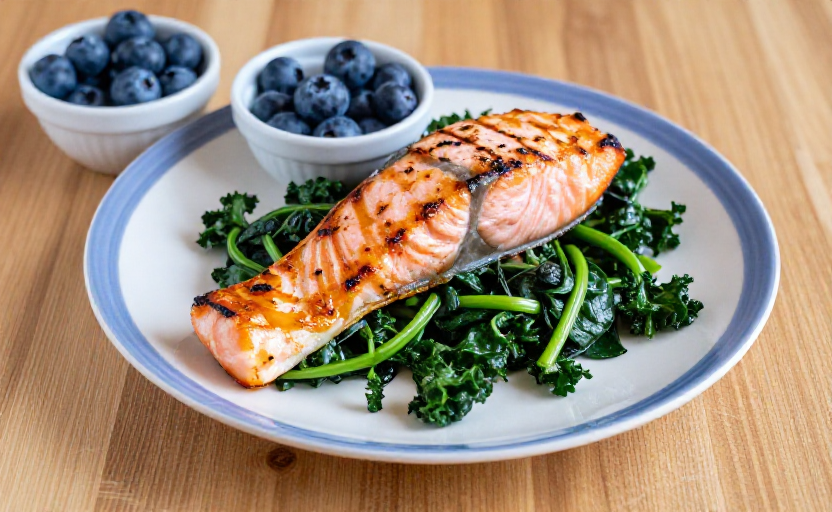
One simple way to incorporate all three foods is to build a meal around them. Think a grilled salmon fillet on a bed of sautéed spinach and kale, with a side of fresh blueberries for dessert. That single plate delivers lutein, zeaxanthin, omega-3s, and anthocyanins in one sitting.
Your eyes are among the most blood vessel-dense tissues in your body. What supports your cardiovascular system supports your vision.
If you are uncertain about making dietary changes, ask your doctor or a registered dietitian who specializes in diabetes. They can help you adjust your meal plan without conflicting with your medications or insulin regimen. Food is not medicine in the prescription sense—but it is foundational tissue-building material. Give your retinas the building blocks they need, and they will thank you for years to come.