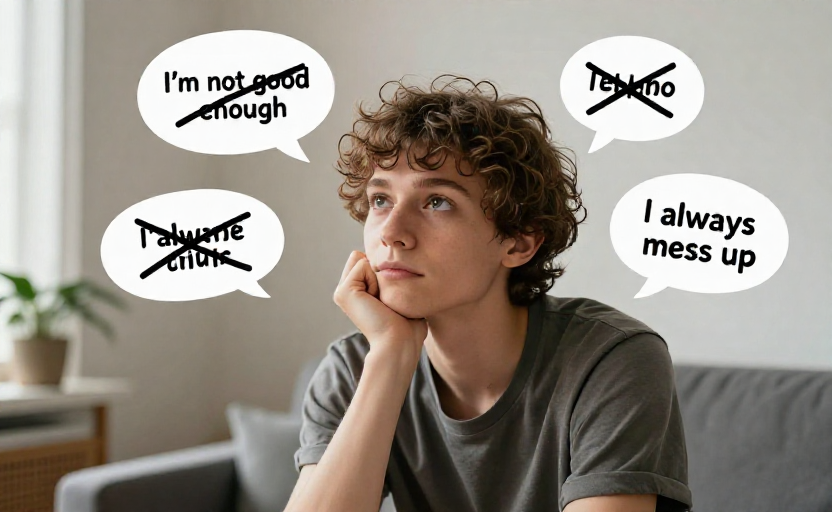
Low self-esteem doesn’t always announce itself with dramatic fanfare. More often, it creeps in through quiet moments—a mistake at work, a friend’s offhand comment, a glance in the mirror that feels a little too critical. And in those moments, the voice in your head can turn harsh. You might hear yourself think things you would never say to someone you love. That inner critic, left unchecked, can deepen the dip and make recovery harder than it needs to be.
Learning what to avoid saying to yourself is one of the most practical steps you can take for your mental health. The words you repeat internally shape your emotional landscape. When you catch yourself sliding into self-defeating language, you have a choice: spiral further, or pause and reframe. This article walks through the phrases that do the most damage when your self-esteem is fragile—and what to try instead.
“I always mess everything up”
Absolute statements like “always” and “never” are rarely accurate, yet they feel convincing when you’re already down. One misstep becomes evidence of a permanent flaw. You drop a ball at work, and suddenly you’re convinced you’re incompetent at everything.
The problem with this kind of thinking is that it leaves no room for context, growth, or the simple fact that humans make mistakes. If you catch yourself using words of total certainty, pause. Ask yourself: Is this really true? Can you think of a single time when things went well? Chances are, you can. That contradiction is your proof that the “always” story is exaggerated.
Try this swap: Instead of “I always mess up,” say “I made a mistake this time, and I can learn from it.”
“I’m not good enough”
Few phrases cut deeper than “I’m not good enough” because it feels like a verdict on your entire worth. It’s a vague, sweeping judgment that doesn’t point to any specific area—it just declares you lacking. This phrase often shows up when you compare yourself to someone else or to an impossible standard.
When you hear this one rolling through your mind, get specific. Ask: Not good enough for what? Compared to whom? Most of the time, the standard you’re failing to meet is either arbitrary or unrealistic. Maybe you didn’t get the promotion, but that doesn’t mean you aren’t a skilled professional. Maybe you struggled with a conversation, but that doesn’t mean you aren’t a kind person.
“Why can’t I be more like [someone else]?”
Comparison is one of the fastest routes to a self-esteem crash. When you measure your behind-the-scenes reality against someone else’s highlight reel, you’re setting up a game you cannot win. Social media makes this especially dangerous: curated images and achievements flash by, and your brain translates them into “I’m falling behind.”
Instead of asking why you can’t be more like someone else, ask what you actually value. What matters to you? Where have you grown in the past year? Comparison often distracts you from your own progress. You’re not meant to live someone else’s life—you’re meant to figure out your own.
“Nobody likes me”
This thought tends to surface after a social rejection or a feeling of invisibility. It feels raw and personal. But it is almost always an overgeneralization. One awkward interaction or a quiet gathering does not mean you are universally disliked. Your brain, in a defensive mode, looks for evidence to confirm the belief—and ignores all the people who do enjoy your company.
When this thought emerges, gently challenge it. Can you name one person who smiled at you today? One friend who replied to your message? One colleague who asked for your opinion? Those small moments are real. They don’t erase the hurt of rejection, but they do help you see that “nobody” is rarely the truth.
Tip: Keep a short list of three people you trust and respect. When the “nobody likes me” thought hits, read their names aloud. It’s a small anchor to reality.
“I’ll never get better”
When self-esteem dips, it can feel permanent. The heaviness convinces you that this is your new normal. Statements like “I’ll never feel good about myself” or “I’ll always be this way” lock the door on hope. They treat a temporary emotional state as a fixed identity.
Dr. Kristin Neff, a leading researcher on self-compassion, has shown that people who talk to themselves with kindness during tough moments recover faster than those who use harsh self-criticism. The key is remembering that feelings are visitors—they come and go. You have felt better before. You will feel better again. The phrase “I’ll never get better” is not a prophecy; it’s a distress signal. Respond with patience, not punishment.
“I don’t deserve good things”
This one can be sneaky. It often masquerades as humility or realism. You might think you’re being honest about your flaws, but what you’re really doing is refusing to accept kindness, success, or love. When you believe you don’t deserve good things, you might sabotage opportunities, push people away, or settle for less than you need.
If you find yourself thinking this, consider the source. Was there a voice from your past—a parent, a teacher, a former partner—that taught you that your worth was conditional? Unpacking that belief takes time, but a first step is simply noticing it and saying, “That’s a thought I was taught, not a fact.” You don’t have to act on it.
How to break the cycle
Knowing what to avoid is half the battle. The other half is building a new inner vocabulary. When you catch one of these harmful phrases floating through your mind, try these three steps:
- Pause and name it. Say to yourself, “That’s the critical voice. It’s not the whole story.” Naming the thought creates distance between you and it.
- Ask a reality-check question. Is this thought 100% true? What evidence do I have that contradicts it? This isn’t about toxic positivity; it’s about accuracy.
- Offer a gentler alternative. You don’t have to swing to the opposite extreme. Instead of “I’m a failure,” try “This was hard, and I’m still learning.” Small shifts in language change how you feel over time.
Building a healthier inner dialogue is a practice, not a one-time fix. You’ll still hear the harsh words—everyone does. But each time you catch them, you weaken their grip. Over weeks and months, your mind learns a new habit: one that treats you with the same patience and fairness you’d offer a good friend.
This article is for general educational purposes only and does not constitute medical or therapeutic advice. If you are struggling with persistent low self-esteem or depression, consider speaking with a mental health professional.