Most people with social anxiety have been told to "just push through it." While well-intentioned, this advice often backfires. The real mistake that keeps the cycle going isn't a lack of effort—it's the hidden strategy of ">safety behaviors."
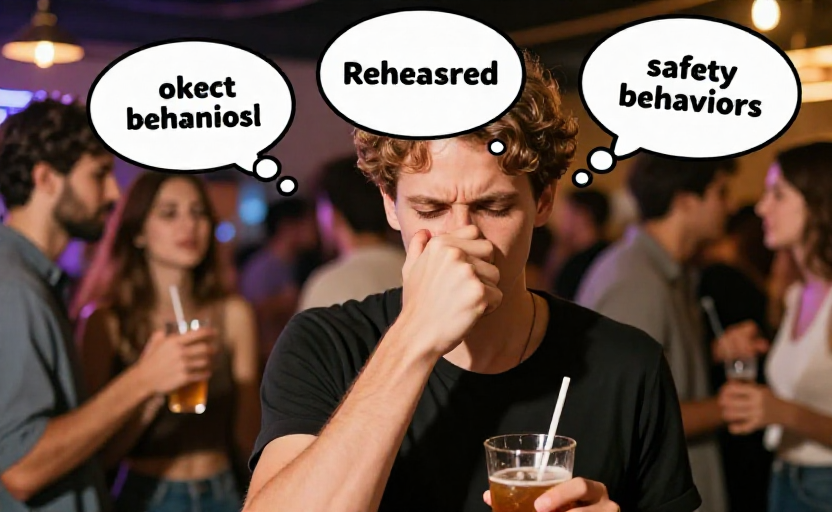
Safety behaviors are small, almost invisible actions you take to feel less anxious in social settings. You might rehearse sentences in your head before speaking, avoid eye contact, grip a drink tightly, or scan the room for the nearest exit. The problem? These tactics may lower your discomfort in the moment, but they actually prevent your brain from learning that social situations are safe. Over time, they keep your anxiety alive and even strengthen it.
What Are Safety Behaviors and Why Do They Trap You?
Anxiety researchers have known for decades that avoidance maintains fear. But safety behaviors are a subtler form of avoidance. You stay in the room physically, but you check out mentally. You might nod along in a conversation without truly engaging, or you stick to people you already know, never testing the waters with new acquaintances.
Every time you rely on a safety behavior, you send a message to your brain: "I only got through that because I held onto my water bottle and didn't say much." Your brain doesn't learn that the social interaction itself was manageable. Instead, it learns that the safety behavior was what got you through. This keeps your threat response on high alert for the next event.
The takeaway: The more you rely on crutches, the less you teach your brain that you can walk on your own.
The Solution: Gradual Exposure Without Crutches
The path out of social anxiety involves letting go of these safety behaviors, one small step at a time. This is not about throwing yourself into terrifying situations. It's about a structured, gentle approach called exposure therapy, ideally guided by a therapist, that you can also start on your own in small ways.
Here are three practical steps to begin dropping safety behaviors:
- Identify your top three safety behaviors. Do you overprepare what you'll say? Do you cross your arms? Do you always sit at the edge of a group? Write down the specific actions you use to feel less visible or less vulnerable.
- Drop one behavior for a short period. Choose a low-stakes situation—like making brief small talk with a cashier or a colleague you know well. For just two or three minutes, consciously stop using one safety behavior. Don't rehearse your words. Make eye contact. Let there be a pause in the conversation without filling it immediately.
- Notice what actually happens. After you drop the behavior, pay attention to the outcome. Did you pass out? Did everyone laugh at you? Most likely, nothing terrible occurred. This is the evidence your brain needs to update its threat map. Over time, these small experiments build a new database of proof that social interactions are survivable—and sometimes even pleasant—without your crutches.
The Role of Mindfulness and Self-Compassion
It's easy to fall into self-criticism when you notice yourself using safety behaviors. "I can't even order coffee without rehearsing it." That inner voice only adds to the anxiety. A more effective approach is mindfulness: noticing the safety behavior without judgment and then gently choosing to try something different.
When you feel the urge to grip your glass or look down, simply notice it. Take a breath. Then, see if you can make one small adjustment—maybe letting your hand rest at your side for five seconds. Each moment of dropping a safety behavior is a victory for your brain's learning process. The goal isn't perfection; it's progress.
Research shows that combining exposure with mindfulness reduces anxiety more effectively than exposure alone. The key is to stay present with the discomfort without fighting it or fleeing from it.
When to Seek Professional Support
Social anxiety exists on a spectrum. For some, safety behaviors are mild habits. For others, they are the only way to function in public. If your social anxiety is severe—if it prevents you from working, maintaining relationships, or leaving your home—please reach out to a mental health professional. Cognitive Behavioral Therapy (CBT) and specifically a type called Social Anxiety Treatment (SAT) are evidence-based and highly effective.
A therapist can help you create a structured hierarchy of exposures, gradually building your tolerance for social risk. They can also help you address underlying beliefs, like "Everyone is judging me," that keep safety behaviors in place.
Conclusion: The Freedom of Letting Go
The social anxiety mistake is not that you feel nervous around people. The mistake is that you've been subtly avoiding the very experiences that could teach your brain to relax. Safety behaviors give you temporary relief but long-term imprisonment in your comfort zone. The solution is not to eliminate anxiety overnight but to start dropping the crutches, one at a time, and let yourself discover what you're truly capable of.
Begin today. Pick one small safety behavior. Drop it for a few minutes. And notice how it feels to be a little more present, a little more real, and a little more free.