If you have been managing blood sugar for a while, you know that carbs are the main lever. Eat too many, and glucose spikes. Eat too few, and you might feel deprived or irritable. The challenge is finding a sustainable middle ground—one that doesn't require a calculator at every meal. Enter the 5:1 carb ratio rule, a practical, food-based guideline that makes balancing your plate a lot more intuitive.
This isn't a strict prescription or a clinical formula. Instead, it is a gentle framework designed to help you build meals that naturally support steadier glucose levels. Think of it as a visual anchor rather than a rigid command. Here is what the rule actually means and how to apply it without overcomplicating your lunch.
What is the 5:1 carb ratio rule?
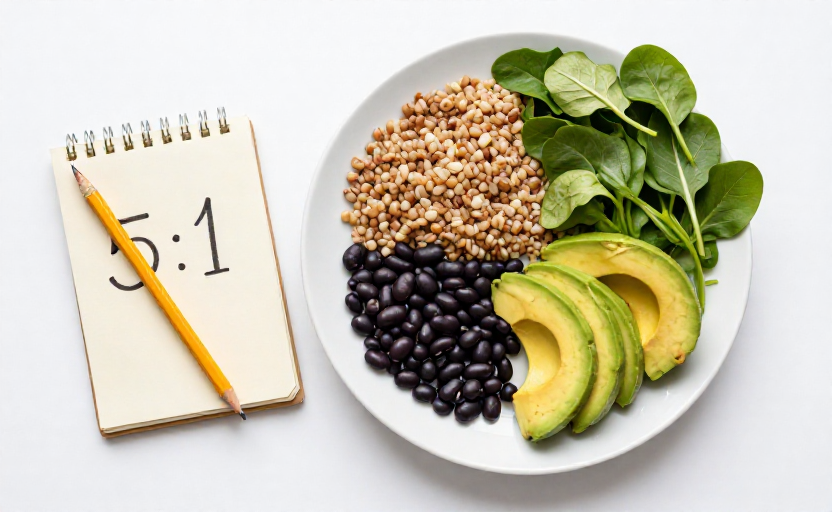
The rule is beautifully simple: for every 5 grams of total carbohydrates you eat, aim to consume at least 1 gram of dietary fiber. In other words, you want a carbohydrate-to-fiber ratio of no more than 5-to-1. If a food or a meal has a ratio higher than that—say 10 grams of carbs for every 1 gram of fiber—it is likely to be quickly digested and may cause a sharper rise in blood sugar.
This ratio was popularised by the late Dr. James Anderson, a pioneer in fibre research, and later championed by the writer Robert Thompson. It works because fiber slows down the absorption of sugar into the bloodstream. Carbohydrates that come packaged with enough fiber are less likely to cause the rapid glucose spikes that can stress your metabolism over time.
Why fiber changes the glucose story
Fiber is the indigestible part of plant foods. It does not break down into sugar like starch or simple carbs do, and it has a direct impact on how your body processes the carbs you eat. When you eat a high-fiber meal, the gel-like consistency of soluble fiber in your digestive tract physically delays the release of glucose into the blood. This means your body has more time to handle the incoming sugar, and your pancreas does not have to release a big burst of insulin to compensate.
Over time, consistently choosing foods with a 5:1 ratio or better can help reduce post-meal glucose variability, support satiety, and lower overall glycemic load—without requiring you to eliminate any food group entirely. It is a positive, additive approach: you add more fiber rather than subtract carbs.
What counts as fiber?
For the rule to work, you need reliable fiber numbers. Focus on total dietary fiber on the Nutrition Facts label, which includes both soluble and insoluble types. Natural fiber from whole foods—legumes, vegetables, fruits with edible skins, whole grains, nuts, and seeds—is far more effective at blunting glucose spikes than isolated, added fibers found in processed bars or low-carb packaged foods, though those can still contribute to your daily total.
How to check the 5:1 ratio on a label
Reading a food label becomes a two-second calculation once you internalise the rule. Look at the line for Total Carbohydrate and the line for Dietary Fiber directly beneath it. Divide the total carbs by the fiber. If the result is 5 or less, you are in a good zone. If it is 6 or above, the food is likely to be more rapidly absorbed.
Example: A serving of black beans has 40 grams of total carbohydrates and 15 grams of fiber. 40 ÷ 15 = 2.6. That is an excellent ratio. A slice of white bread might have 22 grams of carbs and 1 gram of fiber, giving a ratio of 22—far above the threshold.
You can apply this to single foods as a quick quality check, but it is most useful when assessing an entire meal. If your plate contains refined crackers with a high ratio, balance them by adding a high-fiber component like avocado, lentils, or a side of steamed broccoli.
Applying the rule to real meals
The 5:1 rule is not about achieving perfection at every snack. It is a compass that points toward whole, fiber-rich foods. Here is how it might look across an average day.
- Breakfast: Instead of a packaged cereal (often 8:1 or worse), choose oatmeal made with rolled oats. One cup of cooked oatmeal has about 27 grams of carbs and 4 grams of fiber—roughly a 6.8:1 ratio. That is slightly above the target, so you could stir in a tablespoon of ground flaxseed (2 grams fiber, 2 grams carb, ratio of 1) or top it with half a cup of blueberries (ratio of about 3.5). Now your bowl falls comfortably under 5:1.
- Lunch: A whole-grain wrap (look for one with at least 4 grams fiber per serving) stuffed with hummus, sliced vegetables, and a handful of spinach will likely land under a 5:1 ratio. Check the wrap label; many whole-wheat versions are close to 4:1.
- Snack: An apple has about 25 grams of carbs and 4.5 grams of fiber—a ratio of 5.5. That is borderline. Eat it with a handful of almonds (which are low in available carbs and high in fiber) and the overall snack ratio improves significantly.
- Dinner: A lentil curry served over a small portion of quinoa is naturally low on the ratio scale. Legumes typically have ratios between 2:1 and 4:1, making them excellent staples for glucose stability.
Limitations and common misunderstandings
The 5:1 ratio is a useful heuristic, but it is not a flawless predictor of glucose response. Here are a few important caveats to keep in mind.
- It does not account for other macronutrients. Protein and fat also slow digestion and blunt glucose spikes. A meal could have a carb-to-fiber ratio of 8:1 but still produce a modest glucose rise if it contains enough protein or healthy fat. The rule works best as a carbohydrate-quality metric, not a complete picture of a meal’s metabolic impact.
- Not all fiber is created equal. The label lists total fiber, but the type matters for blood sugar benefits. Soluble fiber from oats, barley, legumes, and citrus fruits has the strongest effect on glucose slowing. Foods with mostly insoluble fiber—like wheat bran or nuts—are still beneficial for digestion but may have less of a direct impact on post-meal sugar levels.
- It can encourage overly restrictive choices. Some perfectly healthy foods have a higher ratio. Watermelon, for example, has a ratio around 8:1 because it is mostly water and sugar with very little fiber. Yet eating a moderate serving of watermelon alongside a meal that contains protein and fat does not necessarily spike glucose for everyone. Use the rule as a guide, not a reason to cut out fruits or other nutrient-dense foods entirely.
- Individual variation matters. Your personal glucose response depends on your microbiome, insulin sensitivity, meal timing, and activity level. A food that works for one person may not work for another. The 5:1 rule is a starting point, not a medical directive.
A practical way to use the rule long-term
The real power of the 5:1 carb ratio rule is that it trains your attention on carbohydrate quality rather than quantity. Over time, it nudges you toward whole, plant-based foods without requiring you to count grams obsessively. You might find yourself reading labels more carefully and naturally reaching for beans over white rice, or oats over cornflakes.
If the idea of calculating every ratio feels tedious, simplify further. Aim to include a high-fiber ingredient—legumes, a vegetable, a piece of whole fruit—in every meal and snack. Check the ratio only on packaged foods where you suspect refined grains or added sugar. For most whole foods, the ratio is already in your favor.
Finally, remember that stable glucose is the result of many factors working together: consistent meal timing, adequate sleep, stress management, and physical activity all play roles. The 5:1 rule is one tool in the toolbox—a simple, food-first strategy that aligns perfectly with a balanced, anti-inflammatory way of eating.