Collagen is the structural scaffolding of your skin. Think of it as the protein framework that keeps your face firm, plump, and lifted. For decades, your body produced it in reliable quantities, but around the mid-30s—and accelerating sharply after menopause—that production line begins to slow. For many women, the change is so gradual it feels normal. But for others, the loss happens faster than expected, leaving skin that looks older than their age would suggest.
Knowing the difference between graceful aging and accelerated loss is crucial if you want to preserve your skin's structure. The signs are not vague. They are tangible, visible changes in how your skin behaves. Here are seven specific warning signs that your collagen levels are dropping faster than they should be.
1. You See Fine Lines Where You Never Used To
Everyone gets expression lines around the eyes and mouth eventually. The early warning sign of rapid collagen loss is different: it is the appearance of fine lines in places that are normally smooth. The cheeks. The temples. The area just above the collarbone. When collagen depletes quickly, the skin loses its ability to snap back after a smile or squint, and those temporary creases become etched in. If you notice a web of tiny lines on your cheek when you wake up—lines that stay through the morning—your skin is telling you it has lost structural support.
2. Your Makeup Suddenly Looks Crepey
This is one of the most practical and overlooked signs. You apply foundation or concealer the same way you always have, but it no longer sits smoothly. Instead, it settles into fine lines, looks dry even on oily skin, or gathers in patches. This happens because the skin's surface has become micro-textured. Healthy collagen keeps the skin's surface glassy and tight enough to reflect light. When collagen breaks down faster than it is rebuilt, the surface becomes irregular, and makeup clings to every tiny depression. If you find yourself switching to heavier primers or thicker formulas to mask this effect, your skin is likely losing collagen at an accelerated rate.
3. Your Pores Look Larger (but Not From Oil)
Pore size is largely genetic, but pore appearance changes as collagen around the pore walls weakens. Think of each pore as a tiny hole held open by elastic fibers. When those fibers slacken, the opening widens. If you notice that your pores near your nose or cheeks look more like small dimples than dots—especially if your skin is not oily—the cause is structural laxity rather than congestion. This is a sign that the dermal scaffolding around each pore is deteriorating faster than your body can replace it.
4. Your Skin Droops When You Tilt Your Head
This one is easy to test at home. Stand in front of a mirror and tilt your head forward, looking down at your phone. Then lift your head and watch how your skin settles. In skin with adequate collagen, the tissue springs back almost instantly. In skin that is losing collagen rapidly, the cheeks and jawline will visibly sag for a full second or two before returning to place. This is called the 'snap test,' and dermatologists use it to assess skin laxity. If you notice a delayed return, your skin's elastic network is compromised.
5. Your Jawline Is Looser Than Last Year
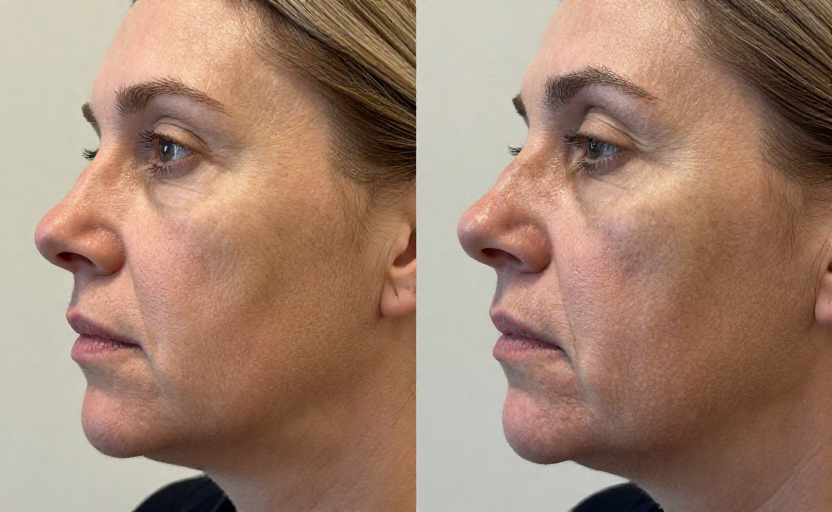
Some facial sagging is normal with age. But accelerated collagen loss produces a specific pattern: the jawline begins to blur even when you are at a stable weight. You might notice that your face looks 'longer' in photos, or that you have developed small jowls above the jawbone. What is happening is not fat gain; it is that the collagen matrix holding the fat pads in place has weakened, allowing the pads to slide downward. If your neck also shows horizontal creases or a 'turkey neck' texture that was not there two years ago, your collagen depletion rate is likely outpacing the average.
6. Your Skin Tears Easily or Bruises More
Collagen is not just in your face—it is the primary protein in your dermis, the thick middle layer of skin that provides tensile strength. When collagen declines steeply, the skin becomes thinner and more fragile. You may notice that a minor bump leaves a bruise for two weeks, or that paper cuts take longer to heal. More tellingly, the skin on your forearms and shins may develop a translucent, papery quality. While this is common in later decades, if you see this in your 40s or early 50s, it suggests systemic collagen loss that extends beyond cosmetic concerns.
7. Your Sun Damage Is Suddenly More Obvious
Everyone accumulates sun damage over a lifetime. But collagen actually helps camouflage existing damage by keeping the skin dense and thick. As collagen vanishes, pre-existing brown spots and discoloration become more pronounced. You might feel that your 'age spots' have darkened or multiplied even though you have been diligent about sunscreen. The explanation is that the surrounding healthy collagen that once diffused the pigment has eroded, leaving the melanin clusters more exposed. If your complexion looks mottled or uneven in a way that feels new, structural loss is likely unmasking old damage.
If several of these signs resonate with you, it does not mean the process is irreversible. Collagen synthesis can be supported with targeted interventions. Retinoids, vitamin C serums, and peptides have research backing for stimulating fibroblast activity. In-office procedures like microneedling and laser resurfacing create controlled micro-injury that triggers a repair response. Nutritionally, adequate protein intake—especially glycine and proline—along with vitamin C and copper provide the raw materials your body needs to build new fibers.
Of course, the most effective strategy is prevention combined with early intervention. Wear broad-spectrum sunscreen daily, avoid smoking, limit sugar (which cross-links collagen fibers and stiffens them), and get consistent sleep. The key is to act before the structural changes become deeply set. Your skin will tell you when it is struggling. The trick is learning to read the signals.