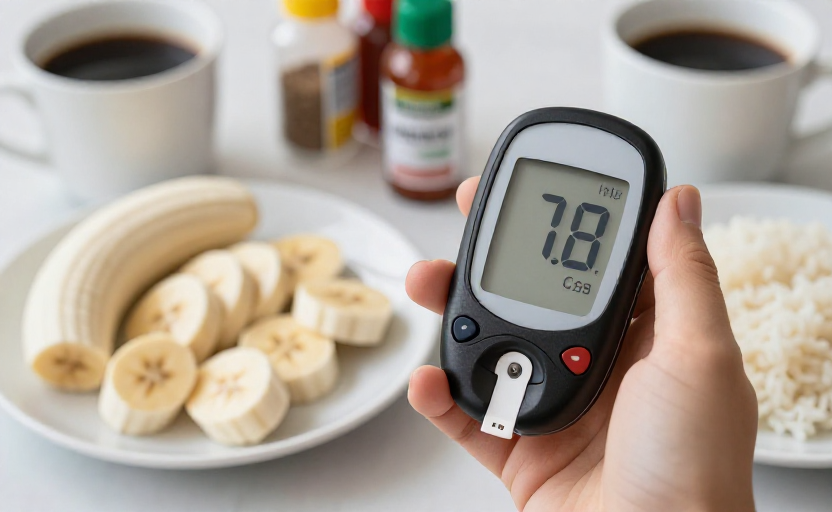
You check your blood sugar, see a number that doesn't match how you feel, and wonder: Is this reading even right? It's a common frustration. Glucose monitors—whether fingerstick meters or continuous glucose monitors (CGMs)—are powerful tools, but they're not infallible. What you ate hours ago, or even just drank alongside your test, can create a temporary blip that has nothing to do with your actual glucose control.
Dietitians who work with diabetes management know these hidden disruptors well. They're not always the obvious sweets. Here are seven foods and ingredients that can skew your glucose readings, along with practical ways to keep your data accurate.
1. Sugary coffee creamers and syrups
Morning coffee is a ritual for millions, but what goes into the cup can trigger a false high. Many flavored creamers list sugar or corn syrup as the second or third ingredient. Even a single shot of vanilla syrup from a pump bottle packs around 5 grams of sugar. When you test soon after drinking that latte, the meter picks up the rapid spike from the liquid sugar—not necessarily a reflection of a meal or your baseline.
Dietitians suggest testing before you add any sweetener to your coffee, or waiting until your blood sugar has stabilized after the drink.
2. High-fructose corn syrup in unexpected condiments
Ketchup, barbecue sauce, teriyaki glaze, and salad dressings are common hiding places. A single tablespoon of some ketchups contains about 4 grams of sugar, nearly all from high-fructose corn syrup. If you test within a couple of hours after a meal that's heavy on these condiments, the rapid absorption of fructose can cause a quicker, sharper rise than a complex carbohydrate would.
The takeaway: a burger with a slather of sweet sauce can create a reading that looks alarming even if the rest of your meal was balanced.
3. White rice and refined grains
This is a classic, but it still trips people up. White rice, instant rice, and sticky rice have a high glycemic index. They break down into glucose very quickly. A CGM reading taken 30 to 45 minutes after a bowl of white rice may show a steep peak that feels disproportionate to the portion size. Dietitians note that the same amount of brown rice or quinoa tends to produce a more gradual curve.
If you're trying to calibrate your insulin or medication timing, swapping one grain for another can dramatically change your post-meal numbers.
4. Glucose itself in dextrose tablets or gels
This may seem obvious, but it's worth stating: glucose tablets, gels, and chews designed for hypoglycemia are pure glucose. They are meant to raise blood sugar. If you take them for a low and then check your blood sugar 10 minutes later, you will likely see a reading that's still low or just recovering. However, if you take them out of habit—or because you're enjoying the taste—and test within 20 minutes, you'll see an artificial spike.
The lesson: use these products only for confirmed lows, and give them time to work before re-testing.
5. Banana (especially overripe ones)
Bananas are a glucose-friendly fruit when green, but as they ripen, their starch converts to free sugars. A spotted, overripe banana can raise blood sugar faster than many cookies. A dietitian might tell you that a large banana eaten alone on an empty stomach can push readings up by 30–50 mg/dL within an hour, making the meter look like you ate a candy bar.
Tip: Pair banana with a protein or fat (like almond butter or yogurt) to slow the sugar absorption and get a more reliable reading afterward.
6. Alcohol, especially beer and sweet cocktails
Alcohol has a paradoxical effect. Initially, a sweet mixed drink or a beer (which contains maltose and sugars) may cause a short-term rise in glucose. But hours later, alcohol inhibits the liver's ability to release stored glucose, which can lead to a delayed low—sometimes while you're asleep. The result is a confusing graph where the meter shows a spike, then a drop that doesn't match your eating pattern.
If you test within 30 minutes of drinking alcohol, the reading may be skewed upward by the liquid sugar, not by your body's true metabolism.
7. Vitamin C supplements (ascorbic acid)
This is the most surprising one. High doses of vitamin C (1000 mg or more) can interact with some glucose meter test strips. The chemical structure of ascorbic acid can be mistaken for glucose by certain enzymes in the strip, leading to a falsely high reading. This is more common with older meter models, but it still occurs. Dietitians advise taking vitamin C supplements at a different time of day than your glucose checks, or at least noting it in your log.
How to get a true picture
If you regularly see odd readings, consider keeping a brief food-and-drink log for three days. Write down everything that goes into your mouth, including condiments, supplements, and beverages. Compare that log against your meter's data. You may spot a pattern—a creamer, a sauce, or a supplement—that's creating the noise.
Your glucose monitor is a guide, not a perfect mirror. By knowing which foods are prone to skew results, you can interpret the numbers with more confidence and avoid chasing false alarms.