When a painful, swollen bump appears on your jawline out of nowhere, it’s natural to wonder: is this just a bad pimple, or something more stubborn? Many people mistake cystic hormonal acne for a standard breakout — and then wonder why their usual spot treatments aren’t working.
The difference matters because the two types of acne respond to very different approaches. While a typical whitehead or blackhead sits near the skin’s surface and often clears within a few days, cystic hormonal acne runs deeper, lasts longer, and follows predictable patterns. Here are the three hallmark signs that set cystic hormonal acne apart.
1. Location Clusters Around the Lower Face and Jawline
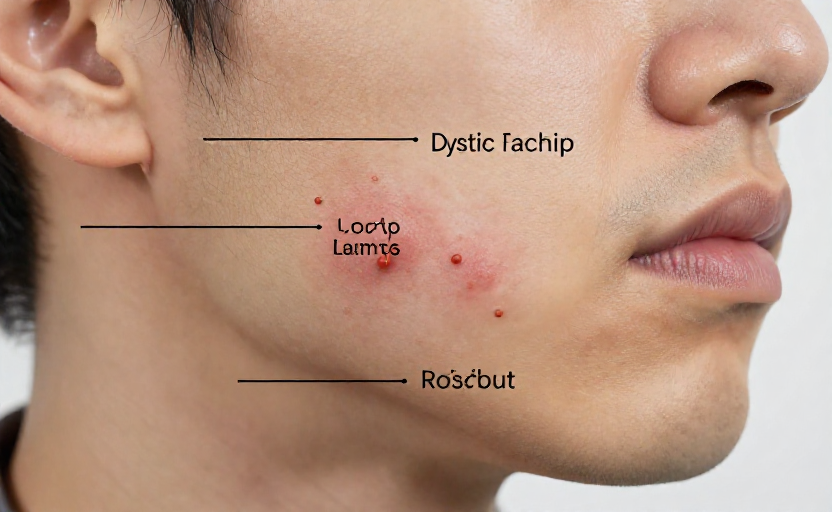
Ordinary pimples can pop up anywhere — your forehead, nose, cheeks, even your back. Cystic hormonal acne, on the other hand, is remarkably predictable in where it appears. It tends to concentrate along the jawline, chin, and lower cheeks, forming a U-shaped pattern from ear to ear.
This happens because the oil glands in these areas are especially sensitive to hormonal fluctuations. When androgen levels rise — before menstruation, during perimenopause, or in conditions like PCOS — those glands go into overdrive, producing thicker sebum that clogs deep pores. If you consistently break out in the same lower-face zone month after month, that’s a strong signal you’re dealing with hormonal acne, not random pimples.
If you consistently break out in the same lower-face zone month after month, that’s a strong signal you’re dealing with hormonal acne.
2. Deep, Painful Lumps Under the Skin – Not Surface Bumps
Touch a typical whitehead and it feels like a small, firm bump close to the surface. You might even be able to extract it (though you shouldn’t). Cystic hormonal acne is entirely different. It feels like a hard, tender knot deep beneath the skin — sometimes for days before any visible redness appears.
These cysts form when a hair follicle wall ruptures deep in the dermis, spilling bacteria, oil, and dead skin cells into the surrounding tissue. The body’s immune response creates significant inflammation, which is why they are painful to the touch. Because the infection is so deep, over-the-counter spot treatments with salicylic acid or benzoyl peroxide rarely reach the root of the problem. If your breakout comes with throbbing or tenderness that makes sleeping on that side uncomfortable, that’s a classic sign of cystic acne.
3. They Take Weeks to Heal and Leave Behind Dark Marks or Scars
An ordinary pimple, left alone, usually peaks within two to three days and fades within a week. A cystic hormonal bump can linger for two weeks or more, and even once the swelling goes down, it often leaves behind a flat, reddish or brownish spot called post-inflammatory hyperpigmentation (PIH). In more severe cases, the deep inflammation destroys collagen, resulting in a permanent depressed scar.
This extended timeline is a direct result of the depth of the inflammation. Healing starts from the inside out, and the surrounding tissue takes time to remodel. If you notice that your breakouts consistently turn into dark spots that take months to fade — or leave small indentations — you are almost certainly dealing with hormonal cystic acne rather than surface pimples.
What to Do If You Suspect Cystic Hormonal Acne
Recognizing these three signs matters because it changes how you approach treatment. Ordinary pimples often respond to gentle exfoliation, non-comedogenic moisturizers, and occasional spot treatments. Cystic hormonal acne usually requires a longer-term strategy that targets the underlying hormonal triggers.
Dermatologists commonly recommend consulting a board-certified professional who can evaluate whether prescription options such as topical retinoids, oral contraceptives, spironolactone, or isotretinoin are appropriate for your situation. No over-the-counter product can correct a hormonal imbalance, so trying random products often leads to irritation and frustration.
Meanwhile, you can support your skin by avoiding picking or squeezing cysts (which worsens scarring), using a gentle cleanser twice daily, and applying a lightweight moisturizer. Some people find that reducing high-glycemic foods or dairy helps, though evidence varies by individual.
The most important step is simply knowing what you’re dealing with. Once you can name it — cystic hormonal acne — you can stop wasting time on treatments that won’t work and start having the right conversation with your dermatologist.