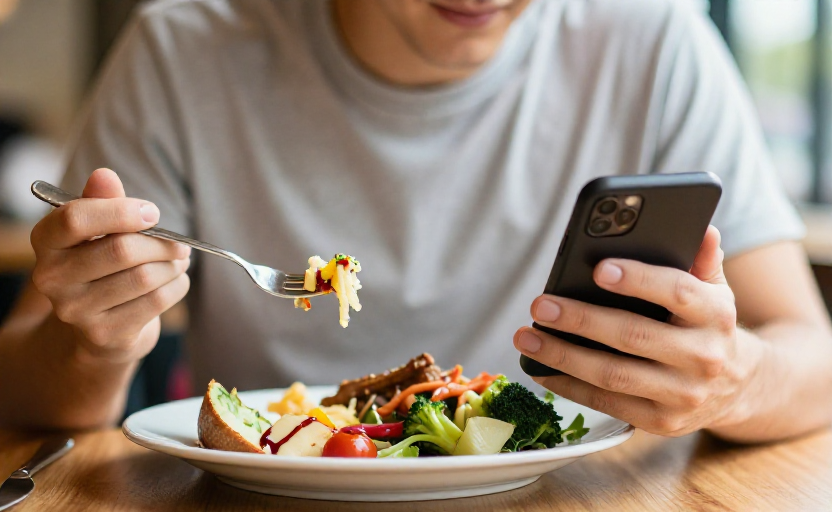
You sit down with a plate of food, and within minutes, your phone is in your hand. Or the TV is on. Or you’re scrolling through emails while mechanically fork-lifting bites. This is not just a modern quirk—it’s a rewiring of how your body signals satiety. When your brain isn’t paying attention to the act of eating, it stops listening to your gut. Here are the three clearest signs that distracted eating is overriding your natural fullness cues.
1. You feel full only after you’ve overeaten
The most immediate red flag is that you don’t sense fullness during a meal, only the heavy, uncomfortable pressure that arrives 20 minutes later. Your brain relies on a chain of signals—smell, taste, texture, stomach stretch—to register satisfaction. When you’re distracted, those signals are muted. Your body may release hunger hormones while delaying the release of satiety hormones like cholecystokinin (CCK) and peptide YY. The result: you keep eating past the point of comfort, and health, and wonder why you feel stuffed.
Take note: If you often feel bloated or regretful after eating, check whether you finished your last meal while scrolling social media or answering work messages. The physical consequence—discomfort—can be your wake-up call.
2. You eat the same meal and feel differently every time
Have you ever eaten a bowl of oatmeal or a grilled chicken salad and felt satisfied one day, but still hungry the next, with no change in ingredients or portion size? This is a classic sign of irregular sensory processing. When you eat mindfully—without screens or conversation that demands attention—your brain can accurately gauge how much you’ve eaten. But distraction scrambles that calculation. Your brain records fewer cues about volume, texture, and flavor, so it doesn’t know when to say “enough.”
A good rule of thumb: if you can’t recall what your last three bites tasted like, you were likely eating on autopilot.
This inconsistency is not about the food itself—it’s about the lack of feedback between your mouth and your hypothalamus. Over time, this can erode your ability to trust your own appetite.
3. You eat more in front of a screen, even when you aren’t hungry
Perhaps the most telling sign is the pattern of eating more than intended when a screen is present. Researchers call this the “video-dinner effect.” In controlled studies, people who ate while watching TV or using a smartphone consumed anywhere from 10% to 30% more calories than those who ate without distractions. Even more striking: they also felt less full after the meal and were more likely to snack later. This isn’t about willpower—it’s about competing cognitive load. Your brain prioritizes visual and auditory stimulation over interoceptive (internal body) signals.
One simple test: Try one meal per day without any screens—no phone, no TV, no tablet. If you find yourself reaching for your device to “keep busy,” you’re likely using distraction to avoid sitting with feelings of fullness or even discomfort. That avoidance can train your brain to ignore satiety entirely.
How to reconnect with your fullness cues
Fixing distracted eating doesn’t demand perfection. Small, intentional adjustments can rebuild the mind-gut connection:
- Set a device-free rule for the first 10 minutes of a meal. This is enough time for your brain to register the initial stretch of your stomach.
- Take three deep breaths before you eat. This shifts your nervous system from “fight or flight” to “rest and digest,” which improves hormone signaling.
- Put down utensils between bites. It slows your eating pace and forces you to check in with your body.
- Notice your first bite and your last bite. This simple awareness anchors your attention to the experience of eating.
You don’t have to eat every meal in silence like a monk. But if you recognize any of the three signs above, your body is telling you it’s time to reclaim your dinner table—not as a workstation or theater, but as a place where you can actually feel full.