You might think of sleep apnea as just a snoring problem or a reason you feel tired during the day. But the connection between sleep apnea and high blood pressure is one of the most direct — and often overlooked — links in cardiovascular health. When you stop breathing repeatedly through the night, your body doesn't just wake you up; it sets off a chain reaction that strains your entire circulatory system.
Here's what happens, and why the effects go far beyond a bad night's rest.
How sleep apnea directly triggers hypertension
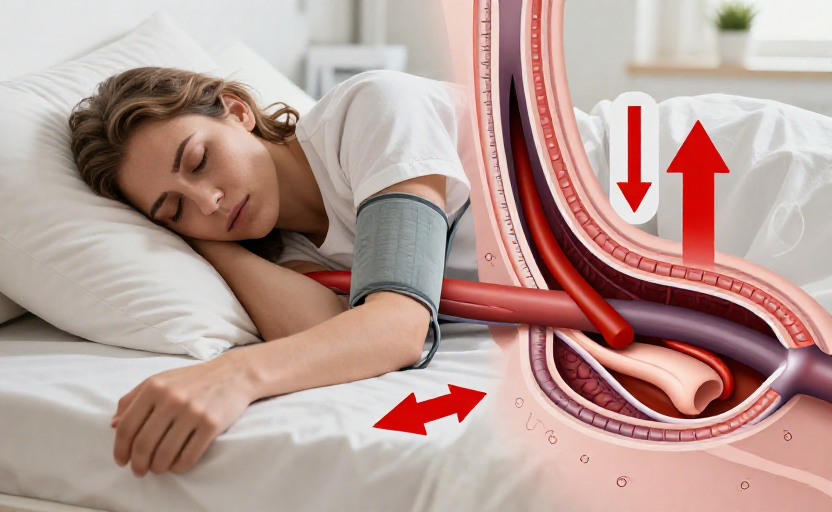
Each time your airway collapses and breathing stops during sleep apnea, the oxygen level in your blood drops. Your brain detects this emergency and sends a signal to your blood vessels: clamp down. This is the sympathetic nervous system kicking into fight-or-flight mode.
The result is a sudden spike in blood pressure. When this happens dozens or even hundreds of times every night, those temporary surges become the new normal. Over time, your blood pressure stays elevated even during the day, when your breathing is normal.
One of the key drivers is the renin-angiotensin-aldosterone system (RAAS), a hormonal cascade that controls blood vessel tone and fluid balance. Repeated hypoxia (low oxygen) keeps this system switched on, causing persistent vasoconstriction — your arteries stay narrower than they should be.
Think of it like revving a car engine every few minutes all night long. Eventually, the engine idles high even when you take your foot off the gas.
1. Stiffening of the arteries (arterial stiffness)
Chronic, untreated sleep apnea doesn't just elevate blood pressure temporarily. It physically changes the structure of your blood vessels. The repeated cycles of oxygen drop and re-oxygenation create oxidative stress — a form of cellular wear and tear.
This oxidative damage degrades the elastic fibers in your artery walls, particularly elastin. Healthy arteries expand and recoil with each heartbeat, helping to buffer pressure. Stiff arteries can't do that, so your heart has to work harder with every beat. The result is higher systolic blood pressure (the top number) and more strain on your heart over time.
A 2020 meta-analysis in the journal Hypertension found that people with obstructive sleep apnea had significantly higher arterial stiffness measurements compared to matched controls, independent of other risk factors like obesity.
2. Increased strain on the right side of the heart
Sleep apnea also affects the pulmonary circulation — the blood vessels that go from your heart to your lungs. When your blood oxygen drops, the small arteries in your lungs constrict. This increases pressure in the pulmonary artery, a condition called pulmonary hypertension.
The right ventricle, which pumps blood into the lungs, has to work harder to push against that resistance. Over months and years, the right heart muscle thickens and can eventually fail (cor pulmonale). While systemic high blood pressure is the more well-known consequence, this pulmonary effect is a second, distinct way sleep apnea strains your heart.
This is one reason why people with sleep apnea are more likely to develop heart failure, not just hypertension.
3. Worsened blood pressure control during sleep (non-dipping)
In healthy individuals, blood pressure naturally dips by 10–20% during deep sleep. This is called nocturnal dipping, and it gives your cardiovascular system a nightly rest. People with sleep apnea often lose this dip.
Instead of dropping, their blood pressure stays at daytime levels — or even rises — throughout the night. This pattern, known as non-dipping, is a strong predictor of cardiovascular events like stroke and heart attack, independent of average daytime blood pressure readings.
Your 24-hour blood pressure monitor might show numbers that look okay, but if the body never gets that nighttime reset, the damage accumulates.
4. Disruption of the body's natural blood pressure rhythm
Sleep apnea doesn't just affect the mechanics of circulation. It also messes with the chemical signals that regulate blood pressure. Chronic intermittent hypoxia alters how your kidneys handle sodium and water. It changes the sensitivity of the baroreceptors (pressure sensors) in your carotid arteries. It promotes systemic inflammation, which damages the inner lining of blood vessels (endothelial dysfunction).
All of these changes together mean your body loses its ability to fine-tune blood pressure across different situations — standing up, exercising, resting, and sleeping. The system becomes less flexible and more reactive, leading to greater variability and higher baseline pressures.
Research in the Journal of Clinical Sleep Medicine shows that treatment with continuous positive airway pressure (CPAP) can partially reverse these changes, especially the loss of nocturnal dipping and the excess sympathetic activation. On average, CPAP reduces systolic blood pressure by 3–5 mmHg, with larger reductions in people who use the device regularly.
What this means for you
If you have sleep apnea — or suspect you do — the long-term effects described here represent real, measurable damage to your cardiovascular system. But the good news is that this process is not inevitable and it is partially reversible.
Treating sleep apnea with CPAP, oral appliances, positional therapy, or weight management can lower blood pressure, reduce arterial stiffness, and restore the normal nighttime blood pressure dip. The improvement often takes several weeks to appear, but it does appear.
If you already have hypertension that is difficult to control with medication, sleep apnea should be near the top of the list of possible underlying causes. Many people find that once their sleep apnea is treated, their blood pressure becomes much easier to manage.
This article is for general health education purposes. If you have concerns about sleep apnea or high blood pressure, please consult a qualified healthcare provider.