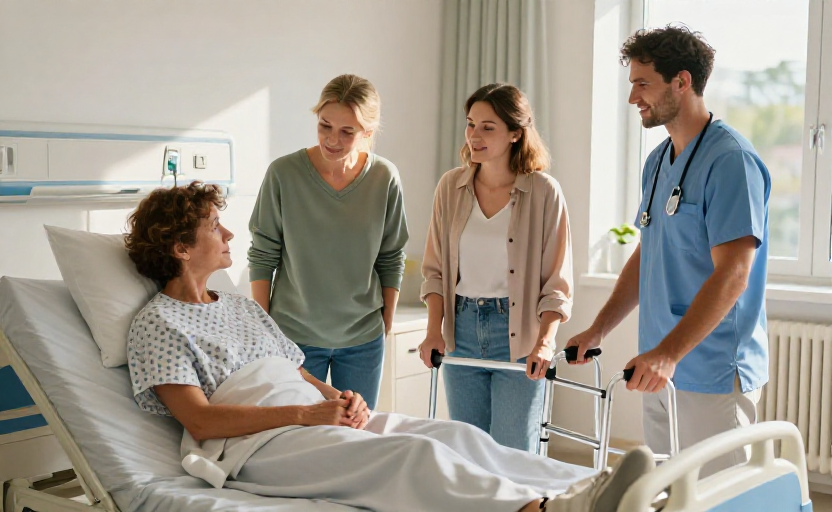
When a loved one has a stroke, the days that follow can feel like a blur of medical terms, hospital corridors, and uncertainty. You are suddenly expected to learn a new language—rehabilitation, occupational therapy, dysphagia, aphasia—while trying to hold your family together. It is overwhelming. And one of the first questions families ask is, What happens next, and for how long?
While every stroke is different—depending on the location and severity of the brain injury, the person's age, and their pre-stroke health—there is a general arc to recovery that can help you prepare. Think of this not as a rigid calendar, but as a map of the terrain ahead. This is what recovery after a stroke typically looks like, week by week and month by month, and what you, as a family member, can expect at each stage.
The acute phase: the first 24 to 72 hours
Right after a stroke, the priority is stabilization. Your loved one is likely in the intensive care unit (ICU) or a specialized stroke unit. Doctors are focused on restoring blood flow to the brain, managing blood pressure, and preventing a second stroke.
At this stage, your role is to be a calm presence. You may not see much progress. The person might be asleep, confused, or unable to speak. This is normal. The brain is in shock. Do not mistake stillness for a lack of awareness. Speak to them in a soft, familiar voice. Touch their hand. Tell them who you are and that they are safe.
One of the most important things you can do in the first days is keep a notebook. Write down every question that comes to mind—medication names, doctor names, test results—so you can ask the care team during their rounds.
The first week: awakening and assessment
Once your loved one is medically stable, usually within a few days, the rehabilitation team will begin a formal assessment. This team often includes a physiatrist (a rehabilitation doctor), physical and occupational therapists, speech-language pathologists, and a social worker. They will evaluate mobility, swallowing, communication, and cognitive function.
Do not expect big leaps yet. The work here is diagnostic. Therapists will see how much strength your loved one has on one side of the body (hemiparesis is common), whether they can safely swallow thin liquids, and how well they can follow simple commands. You may be asked to leave the room during these tests—that is often because patients try harder when family is watching, which can skew results.
If your loved one has a swallowing problem (dysphagia), they may be placed on a modified diet—thickened liquids or pureed foods. This can be frustrating and undignified. Reassure them that it is temporary for many people, but never pressure them to eat or drink something the therapist has not approved. Aspiration pneumonia is a serious risk.
Weeks two through four: the plateau you did not expect
This is often the hardest period for families. The dramatic rescue is over. The neurologist visits less often. The immediate danger has passed. And yet, your loved one may seem to make very little progress. They may still be unable to move an arm. They may cry or laugh at inappropriate times (pseudobulbar affect). They may be irritable or withdrawn.
This is not a setback. It is a plateau, and it is normal. The brain is redirecting resources to healing, and that takes energy. Spontaneous recovery—where some function returns on its own as swelling goes down—is most rapid in the first few weeks, but it is rarely linear. Some days you will see a small gain; other days, a loss.
Celebrate the tiny victories. They lifted their thumb. They swallowed a spoonful of yogurt without coughing. They said your name. Write these down. When you feel discouraged weeks later, you will need to look back and see how far they have come.
Months one through three: intensive rehabilitation and the golden window
Most functional recovery occurs in the first three to six months after a stroke. This is often called the golden window of neuroplasticity—the brain's ability to rewire itself by forming new neural connections. For many patients, this is when they transition from the hospital to an inpatient rehabilitation facility or, if they are strong enough, they go home with outpatient therapy.
Therapy will be intense. Physical therapy focuses on walking, balance, and strength. Occupational therapy works on daily living tasks: dressing, bathing, eating, writing. Speech therapy addresses language (aphasia), cognition, and swallowing. Expect three to five hours of therapy per day in an inpatient rehab setting.
As a family member, you will need to learn how to help without taking over. Therapists will train you in transfers (moving from bed to chair), in offering verbal cues without doing the task for them, and in recognizing signs of fatigue. Neuro-fatigue is real—the brain is working harder than ever, and a short therapy session can be as exhausting as a full day of work.
You will also begin to see your loved one's personality re-emerge, though it may be changed. Stroke can affect emotional control, impulsivity, and social filters. If your quiet father suddenly curses or makes crude jokes, it is the stroke talking. Do not take it personally. Talk to the neuropsychologist on the team about strategies.
Months three through six: the home stretch (and the hard work begins)
By this point, most patients have left inpatient care and are continuing therapy at home or in an outpatient clinic. Progress slows down considerably. The dramatic gains of the first months give way to slow, incremental improvements. This is where many families feel discouraged, thinking recovery has stopped.
It has not stopped. It has just become harder to see.
This is also the time when the caregiver's own health can start to decline. You have been running on adrenaline for months. Now the exhaustion sets in. You may feel isolated, resentful, or guilty for feeling resentful. This is normal. Please find a support group—online or in person—for stroke caregivers. You cannot pour from an empty cup.
Continue therapy at home. Ask the therapists for a home exercise program. Consistency matters more than intensity now. Ten minutes of stretching and weight-bearing exercises twice a day is better than a two-hour session once a week. Use the notebook to track small improvements: a longer step, a clearer sentence, a button fastened alone.
Six months to one year: the new normal
After six months, the rate of recovery typically plateaus further. This does not mean improvement stops—it means it becomes more about adaptation than restoration. The brain has done most of its rewiring. Now the work is about learning to live within new limits while pushing gently against them.
Many survivors continue to make gains for years, especially in speech and fine motor skills, with consistent practice. The idea that “nothing happens after six months” is outdated and harmful. It just takes longer, and the changes are smaller. A stronger grip. Walking a few more feet without a cane. Reading a paragraph without getting lost.
Your family will need to redefine what “recovery” means. For some, it means returning to work and driving. For others, it means being able to transfer from a wheelchair to a toilet independently. Both are victories. Both take courage.
Beyond one year: life after stroke
Stroke recovery is not a project with an end date. It is a lifelong condition. The risk of a second stroke is real, and lifestyle changes—blood pressure control, a heart-healthy diet, regular exercise, no smoking—are non-negotiable. But so is quality of life.
At this stage, your loved one may benefit from community-based programs: stroke recovery groups, adapted yoga or tai chi, art therapy, or communication groups for people with aphasia. These programs provide social connection and purpose, which are as important as any exercise.
And you, the caregiver, need to start thinking about your own future. Many families find that caregiving becomes a new full-time identity. Ask for help. Hire a home health aide for a few hours a week. Accept the meals neighbors offer. Let your siblings take over for a weekend. You are not abandoning your loved one. You are sustaining yourself so you can stay the course.
Recovery after stroke is rarely a straight line. It is more like a spiral: you will pass through the same issues again and again, but each time, you will be a little higher, a little stronger. There will be good days and terrible days. On the terrible days, remember this: you do not need to fix everything today. You just need to get through today. Tomorrow, you try again.