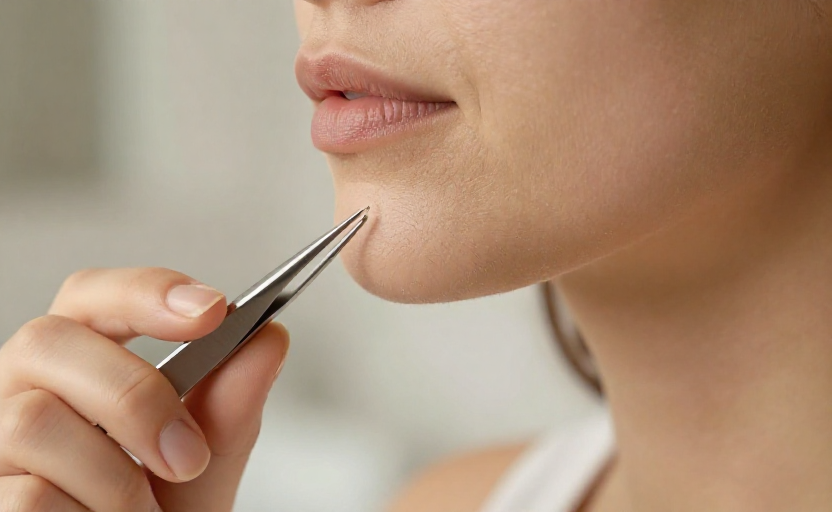
You might think nothing of plucking a few dark, coarse chin hairs every morning. For many women, it is a quick, almost invisible part of their daily routine—a simple grooming habit that keeps a neat appearance. But what if those stray strands are actually trying to tell you something important about your health?
While unwanted facial hair is incredibly common, it can also be an early, subtle signal of Polycystic Ovary Syndrome (PCOS). The danger is that the very habit we use to manage it—tweezing, shaving, waxing, or threading—can effectively hide the evidence from both ourselves and our doctors. Here is what you need to know to recognize the warning sign that should not be left in the trash bin with the tweezing debris.
What is the grooming habit masking?
The medical term for the excessive, coarse, dark hair growth in a male-like pattern on a woman's face, chest, or back is hirsutism. It is a hallmark sign of elevated androgens (male hormones, like testosterone) in the body. For millions of women, this pattern of hair growth is a key red flag for PCOS, a hormonal disorder that affects up to 1 in 10 women of childbearing age.
When you remove these hairs the moment they appear, you effectively erase one of the most visible outward signs of an internal hormonal imbalance. A doctor evaluating a patient for PCOS relies on a set of diagnostic criteria, and whether or not a woman has hirsutism is a major piece of the puzzle.
A quick note on excess hair: If you are regularly removing hair from areas like the chin, upper lip, sideburns, or around the nipples, this is not just ordinary peach fuzz. This is a specific type of hair growth driven by hormones.
Why PCOS matters beyond the hair
PCOS is not just a cosmetic concern. It is a whole-body condition linked to a range of serious health issues. Ignoring the early warning sign of unwanted facial hair can mean missing the chance to address other, less visible problems, including:
- Irregular or absent periods, which can affect fertility.
- Insulin resistance, which significantly raises the risk of developing type 2 diabetes.
- Weight gain and difficulty losing weight, often centered around the abdomen.
- Acne and oily skin, driven by the same excess androgens.
- Thinning scalp hair (female pattern baldness).
Identifying these issues early allows for lifestyle and medical interventions that can dramatically improve long-term health outcomes.
How to distinguish a normal hair from a warning sign
Not every woman will have the same experience, and it is completely normal to have some fine, light-colored facial hair. So how do you know what is a PCOS warning sign versus normal variation?
The Ferriman-Gallwey scale (simplified)
Doctors use a scoring system to determine hirsutism. You can apply this logic to your own habits. Hair that is coarse, dark, and thick—similar to the hair on your head or pubic area—is the type in question. The locations most commonly scored include the:
- Upper lip
- Chin and jawline
- Chest (especially around the breasts)
- Upper and lower back
- Abdomen (especially a line from the belly button downward)
- Upper arms and thighs
If you are routinely removing this type of terminal hair from any of these areas, especially if you have started doing so in the last few years, it is worth taking note.
What to do instead of just picking up the tweezers
You do not have to stop your grooming routine. But the key is to notice it and document it. Here is a practical, health-aware approach:
- Take a photo. Before you remove the hair, snap a clear picture of the area. This provides concrete evidence you can show a healthcare provider.
- Track the pattern. Note when the hair started appearing. Did it coincide with other changes like weight gain, acne, or a change in your menstrual cycle?
- Mention it at your next checkup. Bring up the topic by saying, “I have noticed I need to tweeze dark hairs from my chin every few days. Could this be a sign of a hormone imbalance?”
- Request the right tests. Your doctor may order a blood test to check for free and total testosterone, DHEA-S, and other reproductive hormones, along with glucose and insulin levels.
- You are removing coarse facial hair on a regular (weekly or faster) basis.
- The hair growth has been increasing over the past year or two.
- You also have irregular periods (35 days apart or less than 8 periods per year).
- You are having difficulty getting pregnant.
- You have unexplained weight gain, especially around your midsection, or persistent acne.
When it is time to see a doctor
If any of the following apply, an appointment with a gynecologist or endocrinologist is a smart next step:
These symptoms often travel together, and addressing the root cause can help with all of them simultaneously.
Your daily grooming habit does not have to be the enemy of your health. It can actually be a powerful source of self-awareness. By pausing to recognize what your body is doing, rather than hastily erasing the evidence, you give yourself a head start on diagnosis and care. That stray chin hair might just be the nudge you need to take control of your hormonal health for the long term.