Understanding saturated fat isn't just about reading nutrition labels; it's about visualizing what those numbers mean on your plate. Most health guidelines suggest limiting saturated fat to about 5–6% of your daily calories, which translates to roughly 13 grams for someone eating 2,000 calories a day. But what does 13 grams actually look like spread across your meals? Let's move beyond abstract numbers and see how saturated fat portions appear in the foods you might eat every day.
This guide focuses on practical, visual comparisons. We'll use common household items and standard servings to help you build an intuitive sense of where saturated fat resides, empowering you to make informed choices without needing a calculator at every meal.
Visualizing a Daily Limit
Before diving into specific foods, it helps to have a physical metaphor. Thirteen grams of saturated fat is roughly equivalent to a heaping tablespoon of butter or coconut oil. That's your entire day's recommended limit. It's not a lot when you consider it's distributed across breakfast, lunch, dinner, and snacks. This visual makes it clear why a single rich meal can easily use up—or exceed—your entire daily budget.
Think of your daily saturated fat allowance as one full tablespoon of solid fat. How is it spread across your day?
Saturated Fat in Protein Sources
Animal proteins are often the primary source of saturated fat in many diets. The cut and preparation method make a dramatic difference.
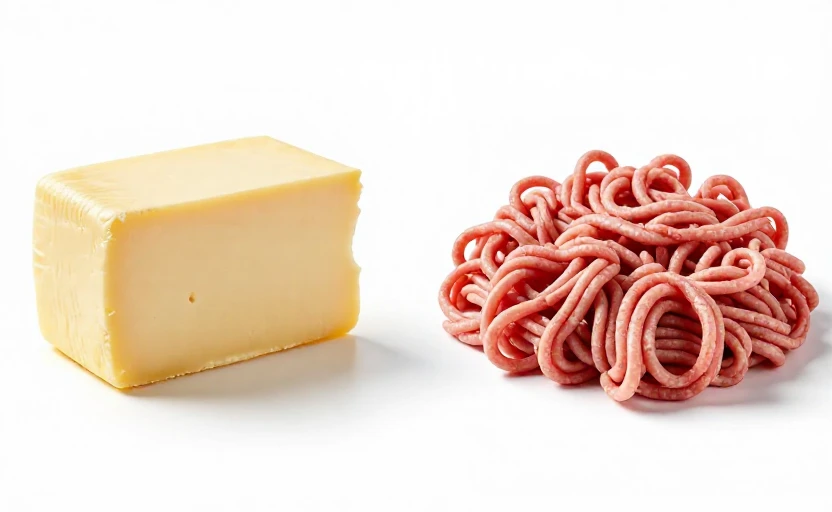
A 3-ounce cooked portion of 85% lean ground beef contains about 6 grams of saturated fat. That's nearly half your daily limit in one modest burger patty. Opting for 90% lean ground beef cuts that to about 4.5 grams. A similar-sized ribeye steak, with its characteristic marbling, delivers around 8 grams, while a leaner sirloin provides about 3 grams.
For poultry, the choice between white and dark meat matters. A 3-ounce serving of roasted chicken thigh with skin has approximately 3 grams of saturated fat. Removing the skin reduces it to about 1.5 grams. The same portion of chicken breast without skin has less than 1 gram.
Processed meats are particularly concentrated sources. Just two links of typical pork breakfast sausage can pack 5–7 grams of saturated fat. Three slices of pan-fried bacon add about 4.5 grams.
Dairy and Alternatives
Dairy products range widely. Full-fat cheeses are dense with saturated fat. Just one ounce of cheddar cheese (a small slice or a couple of cubes) contains about 6 grams. That's a significant portion of your daily limit in a small amount. A single tablespoon of butter has 7 grams.
In contrast, a cup of whole milk has about 4.5 grams, while the same amount of 1% milk has 1.5 grams. A typical 5.3-ounce container of whole-milk plain Greek yogurt has about 4 grams; its nonfat counterpart has virtually none. Swapping full-fat for reduced-fat dairy in your daily routine is one of the most straightforward ways to reduce saturated fat intake without eliminating food groups.
Plant-Based Fat Sources
Not all high-fat foods are created equal. While plant-based foods like coconut and palm oil are high in saturated fat, they don't contain cholesterol. Two tablespoons of canned coconut milk (often used in curries) contain about 6 grams of saturated fat. A tablespoon of coconut oil has about 12 grams. While debates continue about the unique properties of these plant fats, from a pure portion perspective, they are concentrated sources and count toward your daily total.
Pantry Staples and Processed Foods
This is where saturated fat can become less visible. Many processed snacks and baked goods use palm, palm kernel, or coconut oil for texture and shelf stability.
- A medium store-bought chocolate chip cookie might have 2–3 grams of saturated fat.
- A small slice of pound cake can contain 4–5 grams.
- A single serving of many buttery crackers (about 6-8 crackers) often has 1.5–3 grams.
These "sometimes foods" can incrementally add up, making it useful to glance at labels even on items you don't consider traditionally "fatty."
Building a Balanced Plate with Awareness
The goal isn't to eliminate saturated fat entirely, but to be mindful of its concentration. If you enjoy cheese, you might choose a strongly-flavored aged variety and use a smaller amount. If you're having a marbled steak for dinner, you might choose lean protein sources for your other meals that day.
Simple swaps often create the most sustainable change:
- Using avocado or mashed banana in place of some butter in baking.
- Choosing olive oil-based vinaigrettes over creamy dressings for salads.
- Topping a baked potato with Greek yogurt instead of sour cream.
- Snacking on a handful of nuts instead of a buttery pastry.
These adjustments aren't about deprivation; they're about redistribution—allocating your saturated fat "budget" to the foods you truly enjoy most, while finding satisfying alternatives elsewhere.
By familiarizing yourself with these visual portion equivalents, you develop a more intuitive relationship with your food choices. You begin to see that a day of eating is a series of small decisions, each contributing to a balanced whole. Knowledge of what's on your plate, in practical terms, is the first step toward crafting a pattern of eating that supports your long-term well-being.