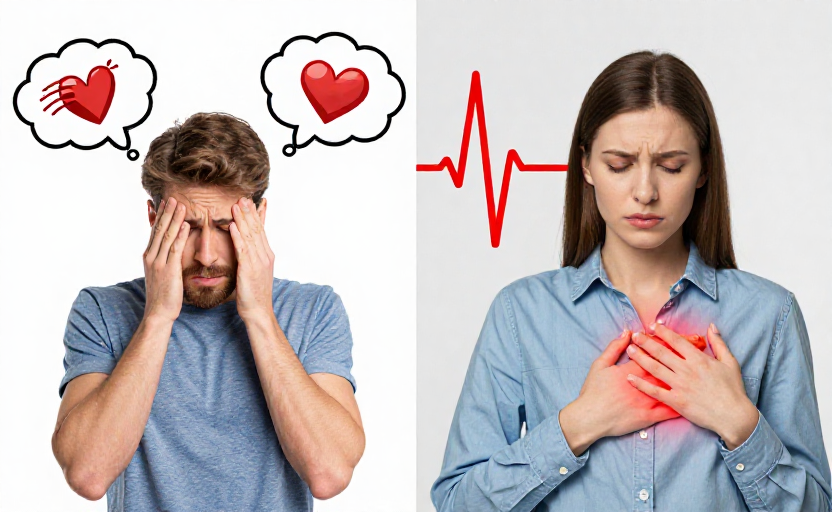
That sudden, sharp pain in your chest. The feeling that your heart is skipping beats or racing out of control. The wave of dizziness and shortness of breath. In that moment, a single, terrifying question can eclipse all others: Is this my heart, or is this anxiety?
It’s a profoundly unsettling experience, and one shared by millions. The physical sensations of a panic attack and certain heart symptoms can feel eerily similar, creating a cycle of fear that only amplifies the distress. Understanding the subtle distinctions isn't about self-diagnosis—it's about empowering you to navigate a frightening situation with more clarity and to seek the appropriate care without delay.
Why anxiety and heart issues feel so similar
Your nervous system doesn't operate in separate, neatly labeled compartments. The same “fight-or-flight” response that gears you up to face a threat—releasing adrenaline, increasing your heart rate, and tensing your muscles—is activated during intense anxiety and can also be triggered by a cardiac event. This shared biological pathway is why the physical overlap is so significant. Your body’s alarm system is sounding; the crucial task is discerning what triggered the alarm.
When in doubt, treat it as a potential heart symptom and seek immediate medical evaluation. It is always the safer choice.
Four key differences to help you discern
While only a healthcare professional can provide a definitive diagnosis, certain patterns can offer clues. Pay attention to the nature, timing, triggers, and accompanying signs of your symptoms.
1. The nature of chest discomfort
This is often the most prominent and frightening symptom. The quality of the sensation can be telling.
Anxiety-related chest pain often feels sharp, stabbing, or like a pinpoint twinge. It may be localized to one small area. People frequently describe it as a “tightness” or “pressure” that comes and goes, sometimes moving around the chest. The pain may worsen when you press on the area.
Heart-related chest pain (angina or heart attack) is more commonly described as a deep pressure, squeezing, fullness, or a heavy weight on the chest. It’s often diffuse, felt across a broader area (not a single point), and may radiate to other places like the jaw, neck, shoulder, back, or down the left arm. This discomfort typically does not change with touch or breathing.
2. How symptoms begin and subside
The timeline and progression provide critical context.
Anxiety symptoms usually peak within 10 minutes and begin to subside within 20 to 30 minutes, though residual feelings of unease can linger. They often arise during periods of stress, worry, or even at rest when ruminating.
Heart symptoms tend to build more steadily. Discomfort from a heart attack typically lasts for more than a few minutes, may come and go, and often intensifies with physical exertion (like climbing stairs) and eases with rest. It is less likely to vanish completely after a short, intense peak.
3. Associated physical signs
Look at the full constellation of what you’re feeling beyond the chest.
With anxiety or a panic attack, you’re likely to experience a cascade of nervous system reactions: hyperventilation (rapid, shallow breathing), tingling or numbness in the hands and feet (often from changes in carbon dioxide levels), a feeling of detachment from reality, and an intense, overwhelming sense of doom or fear that is focused on the immediate physical sensations or a vague catastrophe.
With a cardiac event, accompanying signs are more systemic: cold sweats, nausea or vomiting, lightheadedness to the point of nearly fainting, and profound, unexplained fatigue. The sense of doom may be present but is often coupled with these pronounced physical signs.
4. What triggers the episode
Reflect on what was happening right before the symptoms started.
Anxiety episodes are frequently, though not always, linked to an identifiable stressor—a stressful thought, a conflict, a crowded space, or a reminder of a past trauma. They can also seem to come “out of the blue,” but often occur during periods of generalized high stress.
Heart symptoms are more commonly triggered by physical exertion. For example, chest pain that starts when mowing the lawn, walking uphill, or carrying groceries, and then eases when you stop, is a classic hallmark of angina (reduced blood flow to the heart).
When to seek immediate medical help
Certain symptoms should never be dismissed or attributed to anxiety without a professional evaluation. Use the acronym ACT as a guide:
- A - Angina-like pain: Pressure, squeezing, fullness, or pain in the center of your chest that lasts more than a few minutes or goes away and comes back.
- C - Concerning spread: Discomfort that spreads to your jaw, neck, back, stomach, or one or both arms (especially the left).
- T - Troubling signs: Accompanied by shortness of breath, cold sweat, nausea, lightheadedness, or overwhelming fatigue.
If you experience these, call emergency services immediately. Do not drive yourself. It is far better to have a false alarm checked out than to ignore a true emergency.
Navigating the path forward
If you’ve experienced these frightening symptoms and a cardiac cause has been ruled out by a doctor, you’re facing a different but very real challenge: managing the anxiety that creates such convincing physical distress.
This is where a dual approach helps. Working with a therapist, particularly one trained in cognitive behavioral therapy (CBT), can provide tools to interrupt the cycle of fearful thoughts and physical sensations. Simultaneously, practices like diaphragmatic breathing (deep belly breathing) can directly calm the nervous system and counter the hyperventilation of a panic attack.
Remember, the goal isn’t to become your own cardiologist. It’s to develop enough understanding to respond wisely—prioritizing urgent care when needed and pursuing supportive strategies for anxiety when appropriate. Your body is asking for your attention; learning its language is the first step toward finding calm and care.