

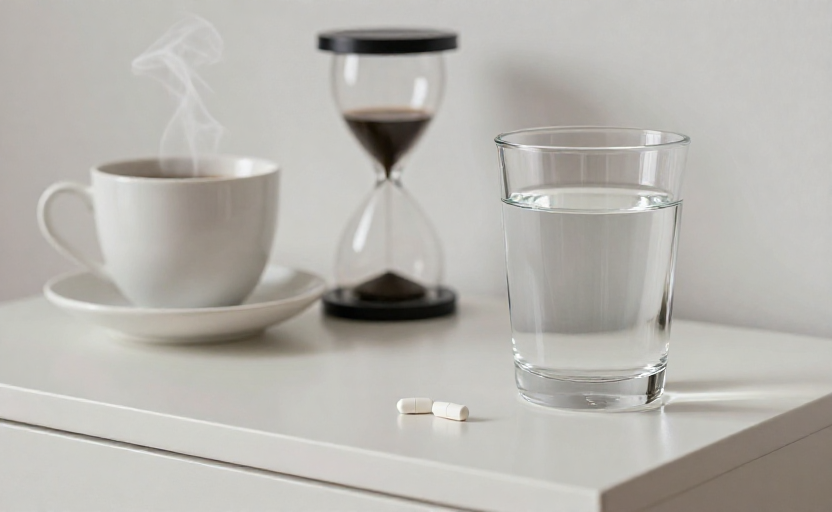
For many people, the morning ritual of a hot cup of coffee is non-negotiable. But if you take thyroid medication—most commonly levothyroxine—that same ritual might be quietly undermining your treatment. The question isn't whether you have to give up coffee; it's about how you time both so they work together.
The good news is that you don't need to choose between your thyroid health and your morning brew. A straightforward schedule, backed by pharmacology, allows you to enjoy both without compromise. Here's what you need to know about the interaction and three timing strategies that make coffee and thyroid medication compatible.
The Core Issue: Absorption Interference
Thyroid medications, particularly levothyroxine (Synthroid, Levoxyl, and generics), are notoriously sensitive to what is in your stomach at the time of ingestion. The drug's absorption occurs primarily in the small intestine, and certain substances can bind to the medication, preventing it from crossing into your bloodstream.
Coffee is one of those substances. To be precise, it is not the caffeine alone—though caffeine can play a minor role—but rather the coffee itself, including its oils, polyphenols, and other compounds.
A 2008 study in Thyroid found that drinking coffee reduced levothyroxine absorption by roughly 25 to 40 percent compared to taking the medication with water only.
— Journal of Clinical Endocrinology & Metabolism (related research)
That drop is clinically meaningful. If you are consistently absorbing only 60–75% of your dose, your TSH levels can drift upward, symptoms of hypothyroidism can return (fatigue, weight gain, brain fog), and your doctor may increase your dose to compensate—creating a cycle that never quite resolves.
Why Morning Coffee Is the Trickiest Time
Most people take their thyroid medication first thing in the morning on an empty stomach, exactly as instructions recommend. The standard guidance is to wait 30 to 60 minutes before eating or drinking anything other than plain water. The problem? Coffee is not water, and 60 minutes may not be long enough.
Research suggests that coffee's binding effect can persist longer than 60 minutes in some individuals. While the half-life of coffee compounds in the gut varies, many experts now advise a longer window—or a different timing strategy altogether—to ensure reliable absorption.
3 Timing Tips That Work
These three approaches are based on pharmacokinetics and published clinical guidance. Pick the one that fits your routine best.
1. The Strict Window: 60–90 Minutes of Separation
Take your medication with a full glass of plain water (tap or filtered). Wait a full 60 to 90 minutes before drinking coffee. This is the simplest method and does not require changing your morning routine drastically—just shifting your coffee back a bit.
- Set your medication and water on your nightstand. Take it as soon as you wake up.
- Go about your morning routine: shower, dress, feed the dog.
- Pour your coffee when the timer goes off.
This works reliably for most people. The key is the gap, not the type of coffee. Black, with milk, espresso, decaf—it all has the same potential to interfere because it's the coffee itself, not caffeine, that matters.
2. The Bedtime Switch: Take It Before Sleep
An alternative that sidesteps the morning problem entirely: take your thyroid medication at bedtime. A 2010 study published in the Archives of Internal Medicine found that bedtime administration of levothyroxine resulted in better thyroid hormone levels compared to morning administration, likely because the stomach has been empty for several hours and remains so until breakfast.
- Take medication with water at least 2 hours after your last meal or snack.
- Avoid evening coffee or other beverages besides water for at least 2 hours before.
- This method means morning coffee is completely unaffected.
Some people find this easier to remember, though it doesn't work well if you eat or drink late at night. Check with your healthcare provider before switching from morning to bedtime, but it is a well-supported option.
3. The Morning Swallow, Then Coffee (With a Caveat)
If you absolutely must coffee within 30 minutes, consider this compromise: take the medication with a sip of water, then drink very small amounts of black coffee—1 to 2 ounces—and wait a full hour before consuming a full cup. This is not ideal for absorption, but it is better than downing a 12-ounce pour-over immediately after your pill.
However, I want to be straightforward: this is the least reliable method. If your thyroid levels are stable and you are consistent, it might work. But if you are struggling with symptoms or adjusting your dose, do not rely on this shortcut. The strict window or bedtime method is safer.
What About Decaf, Cold Brew, or Coffee with Milk?
The interference is not about caffeine, so decaf is equally problematic. Cold brew, which is typically more concentrated in coffee solids, may actually be more likely to interfere due to higher levels of chlorogenic acids and other polyphenols. Adding milk or cream does not neutralize the effect—it does not change the coffee's structure enough to prevent binding.
Neither does switching to tea, necessarily. Black and green teas also contain polyphenols (tannins) that can inhibit thyroid hormone absorption, though the effect is generally less pronounced than with coffee. If you swap coffee for tea, still maintain a 60-minute window.
One Tablet or Two? Consistency Matters More Than Perfection
Take your medicine the same way every day. Consistency in timing, with the same beverage (or none), gives your doctor the cleanest data for dose adjustments.
If you occasionally have coffee after 45 minutes instead of 60, that is probably fine. But if you are regularly taking medication with a splash of coffee or sipping it within 15 minutes, you are likely absorbing an unpredictable amount. That variability makes it much harder to dial in the right dose. Stick to one method and make it a habit.
When to Talk to Your Doctor
If you have been taking your thyroid medication with coffee (or shortly before it) and your thyroid levels are stable, your doctor may not insist you change. Some people are naturally more resistant to absorption interference, or their dose was simply adjusted upward to compensate without anyone realizing the cause.
However, if you are experiencing fatigue, weight changes, hair thinning, or elevated TSH levels despite taking your medication, bring up your coffee timing specifically. Ask your provider: “Could switching my coffee window or moving to bedtime help my absorption?” They can order follow-up labs 6–8 weeks after a change to verify improvement.
In the end, coffee and thyroid medication can coexist peacefully—it just takes a little planning. Choose one of the three timing strategies above, stick with it consistently, and you can protect your thyroid function without giving up the comfort of your morning cup.








