Your body speaks a subtle, daily language of fertility, and learning to understand it can be one of the most empowering tools for your reproductive health. While many of us track our cycles by the calendar, there’s a more immediate, physical sign that offers a clear window into your most fertile days: cervical mucus. This natural substance, often overlooked or misunderstood, changes in texture, color, and volume in a predictable pattern throughout your menstrual cycle, directly reflecting the hormonal shifts that control ovulation.
By simply observing these changes, you can identify when you are approaching ovulation—your fertility window—and gain deeper insight into your overall cycle health. This isn't about complex medical equipment; it's about tuning into the wisdom of your own body. Let's explore what cervical mucus is, what the different types mean, and how to track it effectively.
What is cervical mucus and why does it change?
Cervical mucus is a fluid produced by glands in your cervix. Think of it as a gatekeeper and a facilitator. Its primary roles are to protect the uterus from bacteria and, crucially, to help or hinder sperm on their journey. The consistency of this mucus is governed by your hormones, primarily estrogen and progesterone.
Right after your period, estrogen levels are low. As your body prepares for a potential pregnancy, estrogen begins to rise. This surge directly alters the quality of your cervical mucus, making it more abundant, slippery, and stretchy—creating an ideal environment for sperm to survive and swim toward the egg. After ovulation, progesterone takes over, causing the mucus to thicken and dry up, forming a protective plug.
The fertility spectrum: understanding your mucus signs
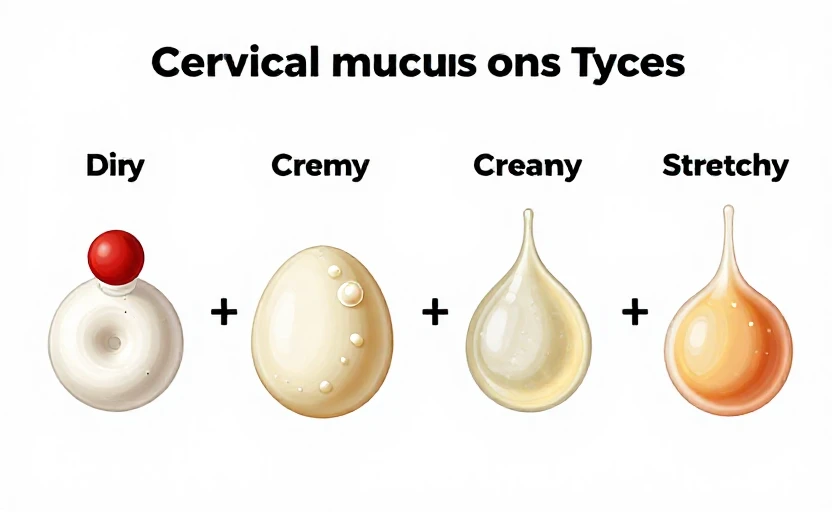
Cervical mucus transitions through several distinct stages in a typical cycle. Observing these stages helps you pinpoint where you are.
Dry or sticky days (low fertility)
Immediately following your period, you may experience few days of dryness or notice only a small amount of mucus that is sticky, tacky, or pasty. It might be white or cloudy and breaks easily when stretched between your fingers. This indicates lower estrogen levels and a less fertile phase.
Creamy or lotion-like days (transitional fertility)
As estrogen rises, mucus often becomes creamier, resembling hand lotion. It may be white, yellowish, or cloudy and have a smoother, wetter feel. This is a sign that fertility is increasing and ovulation is on the horizon.
The most fertile mucus is often described as having the consistency of raw egg whites—clear, slippery, and stretchy.
Egg white cervical mucus (peak fertility)
This is the most significant sign of high fertility. Known clinically as spinnbarkeit, this mucus is clear, slippery, and remarkably stretchy—often able to stretch an inch or more between your fingers without breaking. It provides the perfect alkaline, nutrient-rich channel for sperm to travel through and can survive for several days inside the body. The presence of this quality of mucus signals that ovulation is likely to occur within the next day or two.
Back to dry or sticky (post-ovulation)
After ovulation, the mucus quickly changes again, becoming thicker, cloudier, or disappearing entirely as progesterone dominates. This marks the end of the fertile window.
How to track your cervical mucus effectively
Tracking is straightforward and requires nothing more than mindful observation. The best method is to check your mucus at least once a day, ideally when you go to the bathroom.
- Observe visually: Notice the color (clear, cloudy, white, yellowish) on toilet paper or your underwear.
- Check consistency: Before wiping, use clean fingers to collect a sample from your vaginal opening. Gently press your fingers together and then slowly pull them apart to see if the mucus stretches.
- Note the sensation: Pay attention to how you feel throughout the day. Do you feel dry? Damp? Wet and slippery? This internal sensation is a key part of the observation method.
- Record your findings: Keep a simple chart or use a fertility app to note the quality (dry, sticky, creamy, egg white, etc.) and sensation each day. Over a few cycles, your personal pattern will become clear.
What your cervical mucus can tell you beyond fertility
While identifying your fertile window is a primary benefit, tracking cervical mucus offers other valuable insights into your gynecological health.
Consistent, cyclical changes are a good sign of regular hormonal activity and ovulation. A lack of observable fertile-quality mucus over several cycles could suggest anovulation (not ovulating) or low estrogen, which may be worth discussing with a healthcare provider. Conversely, noticing changes like a persistent fishy odor, unusual green or gray color, or accompanying itchiness can be an early sign of an infection, prompting you to seek care.
Common questions about cervical mucus
Can medications or lifestyle factors affect it? Yes. Antihistamines can dry up cervical mucus just as they dry up nasal passages. Clomid (a fertility drug) can also alter its quality. Staying well-hydrated is important, as dehydration can reduce mucus production.
What if I don't see egg white mucus? Not everyone experiences textbook-perfect egg white mucus. Your "peak" mucus might be very watery and clear, or consistently creamy but still noticeably wet and slippery. The key is to learn your body's unique pattern of change. If you see no change at all over multiple cycles, a consultation can provide clarity.
How does this method work with irregular cycles? For those with irregular cycles, tracking cervical mucus can be even more valuable than calendar tracking alone. Your mucus will still follow the hormonal pattern leading up to ovulation, whenever it occurs, giving you a real-time sign of your fertility status regardless of cycle length.
Learning the language of your cervical mucus is a gentle, non-invasive way to connect with your body's natural rhythms. It demystifies your cycle, putting practical knowledge about your fertility directly in your hands. With a little patience and observation, you can use this guide to better understand your unique pattern, empowering you whether you are planning for a pregnancy or simply seeking a deeper awareness of your health.