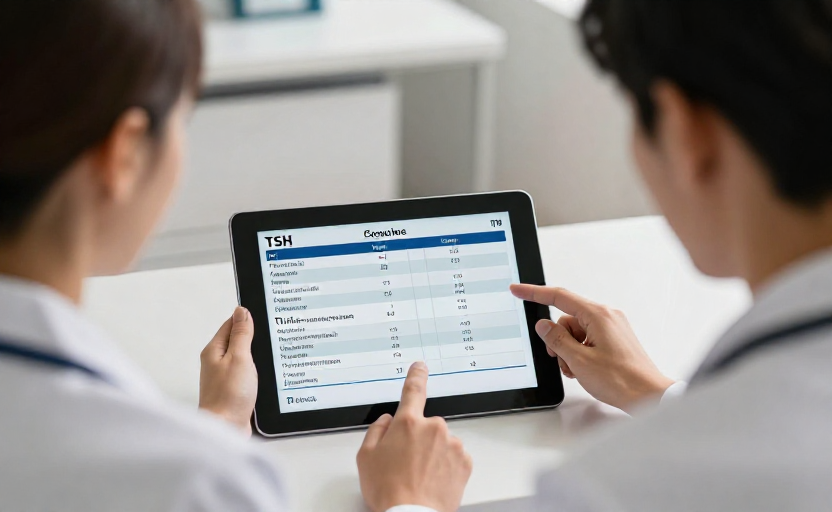
If you’ve had blood work done and seen the words TSH, T4, or T3 on the results, you are not alone in wondering what they actually mean. Thyroid function tests can look like a jumble of abbreviations and reference ranges, but they are simply measurements that help your healthcare provider see how well your thyroid gland is working. Understanding the basics of what these numbers represent can give you a clearer picture of your health and make your next conversation with your doctor more productive.
Think of your thyroid as the body’s thermostat. It sets the metabolic pace for nearly every organ. When it runs too fast, you might feel anxious or lose weight without trying; when it runs too slow, fatigue and weight gain can creep in. The tests below are the standard tools used to check that thermostat. Let’s walk through each one in plain language.
TSH: The Maestro of the Thyroid
TSH, or thyroid-stimulating hormone, is produced by the pituitary gland in your brain. Its job is to signal your thyroid to release more of its own hormones (T4 and T3). Think of TSH as the messenger. If your thyroid hormone levels are low, the pituitary sends out more TSH to try to wake the thyroid up. If levels are high, the pituitary dials back the TSH.
What a high TSH usually suggests: Your thyroid is underactive (hypothyroidism). The brain is shouting for more thyroid hormone, but the gland isn’t responding. A result above the lab’s reference range (often above 4.5 mIU/L, though this can vary) is a common indicator.
What a low TSH usually suggests: Your thyroid is overactive (hyperthyroidism). The gland is producing too much thyroid hormone, so the pituitary has stopped sending signals. A suppressed TSH (often below 0.4 mIU/L) points in this direction.
There are exceptions—pregnancy, certain medications, and pituitary disorders can shift the numbers—so TSH alone is rarely the whole story.
T4: The Storage Hormone
Thyroxine, or T4, is the main hormone your thyroid gland produces. It circulates in your blood in two forms: bound to proteins (which is inactive) and free (which can enter tissues). Most labs measure free T4 (FT4) because it reflects what is available for your body to use.
Free T4 levels: A low free T4 alongside a high TSH confirms hypothyroidism. A high free T4 with a low TSH suggests hyperthyroidism. In some cases, you can have normal T4 but abnormal TSH—this is where the nuance comes in, and why your doctor looks at the whole panel.
Certain medications like birth control pills or estrogen therapy can raise total T4 without affecting free T4, which is why free T4 is the more reliable number.
T3: The Active Hormone
Triiodothyronine (T3) is the more potent, active form of thyroid hormone. Most T3 in your body comes from the conversion of T4 in your liver and other tissues. Because T3 is so powerful, levels are usually measured when hyperthyroidism is suspected or when a person’s symptoms suggest the conversion process might be off.
When it’s checked: Not everyone needs a T3 test. It is often ordered if TSH is low and T4 is normal but symptoms of an overactive thyroid persist. High T3 levels can point to a specific type of hyperthyroidism called T3 toxicosis. Low T3 is seen in severe illness or sometimes in people with hypothyroidism, though it is less useful for diagnosing the condition itself than TSH and T4 are.
Testing free T3 (FT3) is generally preferred over total T3 for the same reason—it better reflects what is bioavailable.
Thyroid Antibodies: The Autoimmune Clue
When your thyroid test results don’t fit a clear pattern, or when you have a family history of autoimmune disease, your doctor might order antibody tests. These measure whether your immune system is attacking the thyroid.
TPO antibodies (thyroid peroxidase antibodies): Found in more than 90% of people with Hashimoto’s thyroiditis (the most common cause of hypothyroidism) and about 80% of those with Graves’ disease (the most common cause of hyperthyroidism).
Tg antibodies (thyroglobulin antibodies): Also associated with Hashimoto’s, and sometimes monitored after thyroid cancer treatment.
TSH receptor antibodies (TRAb or TSI): Specific to Graves’ disease. A positive test is a strong indicator that the hyperthyroidism is autoimmune.
A positive antibody test does not always mean you need treatment—some people have antibodies without any thyroid dysfunction—but it provides context for why your hormone numbers might be fluctuating.
Putting It Together: What the Patterns Mean
Rather than memorizing reference ranges, it’s more useful to recognize common patterns:
- High TSH + Low free T4: Primary hypothyroidism (the thyroid itself is underperforming).
- Low TSH + High free T4 and/or free T3: Primary hyperthyroidism (the thyroid is overproducing).
- Low TSH + Normal free T4 and T3: This could be subclinical hyperthyroidism or a pituitary issue, depending on the full picture.
- High TSH + Normal free T4: Often called subclinical hypothyroidism—the thyroid is still managing to keep T4 in range, but the pituitary is working harder.
- Low TSH + Low free T4: This unusual pattern can point to a problem with the pituitary gland itself (central hypothyroidism).
Note: Reference ranges differ from lab to lab and can change based on age, pregnancy, and existing thyroid treatment. The numbers listed here are general guidelines, not cutoff points for diagnosis.
What About “Normal” but Not Feeling Normal?
One of the most common frustrations people report is having test results that fall within the lab’s reference range but still experiencing fatigue, brain fog, or temperature sensitivity. This is a legitimate area of ongoing research and clinical debate.
For some people, the “optimal” TSH level may be on the lower end of the range (around 1–2 mIU/L). Being on the high end of normal (like 4.0 mIU/L) could feel different for one person compared to another. If you feel unwell but your results are normal, it’s important to share that with your doctor. They may consider retesting, checking additional markers like reverse T3, or exploring whether other conditions (like iron deficiency or adrenal issues) could be contributing to your symptoms.
Frequently Asked Questions
How often should I get thyroid tests?
If you have a stable thyroid condition and are on medication, annual testing is typical. If you are newly diagnosed or adjusting medication, your doctor may test every 6–8 weeks until levels stabilize. For routine screening in adults without symptoms, guidelines vary; many experts recommend starting at age 35 and repeating every 5 years, but this is a discussion to have with your healthcare provider.
Can food or supplements affect my thyroid test results?
Yes. Biotin (a common B vitamin supplement) can interfere with many thyroid hormone assays, causing falsely high or falsely low readings. It is generally advised to stop biotin supplements 3–5 days before blood draws. Iodine—both too much and too little—can also shift thyroid function, as can certain soy products and cruciferous vegetables when eaten in extremely large amounts. These effects are usually minimal unless you have an underlying deficiency or autoimmune condition.
Do I need to fast before a thyroid blood test?
Some labs and endocrinologists recommend fasting in the morning because levels of TSH follow a circadian rhythm (peaking at night) and can be slightly blunted by food intake later in the day. For the most consistent results, morning sampling without food is preferred, but it is not absolutely required for all tests. Follow your lab’s instructions.
What if my thyroid test results are borderline?
Borderline results are common. Your doctor will consider your symptoms, family history, and whether you are planning pregnancy. A mildly elevated TSH with no symptoms may not require treatment, but it warrants monitoring. If symptoms are present, a trial of low-dose thyroid medication is sometimes offered and then reassessed. The decision is individualized.