Period trackers are a go-to tool for many people who menstruate. They help you predict your next period, know when you're ovulating, and log symptoms. But if you have endometriosis — or suspect you might — your tracker might be showing you important clues without you realizing it. The condition is notoriously underdiagnosed, and subtle patterns in your cycle data can be the key to spotting it earlier.
Here are five warning signs in your period tracker that could point to an endometriosis pattern. If any of these sound familiar, it's worth bringing your data to a gynecologist who specializes in endometriosis.
1. Your period never really follows a predictable 28-day rhythm
Many period apps assume a regular cycle, but endometriosis often throws that predictability out the window. If your tracker consistently shows cycles varying by more than a few days each month — say, 24 days one month and 33 the next — that variability itself could be a clue. Endometriosis can affect hormone signaling and ovulation, leading to irregular or anovulatory cycles. A pattern of erratic cycle lengths, or cycles that look regular on the app but feel completely different in terms of pain and bleeding, should not be dismissed.
2. Your most severe pain falls outside the typical “cramp window”
Most people expect some cramping during the first day or two of menstruation. But your tracker might reveal a different story. Pain that consistently starts a week before your period, lasts several days after bleeding stops, or clusters around ovulation is not standard menstrual cramping. If your app shows you logging mid-cycle pain (around day 14 in a typical cycle) or pain right before your period that is severe enough to interfere with daily life, endometriosis might be at the root.
One key difference: Cramps from endometriosis often feel like a deep, stabbing ache low in the pelvis or lower back, rather than the dull, diffuse pressure of typical period pain.
3. Heavy or prolonged bleeding shows up consistently
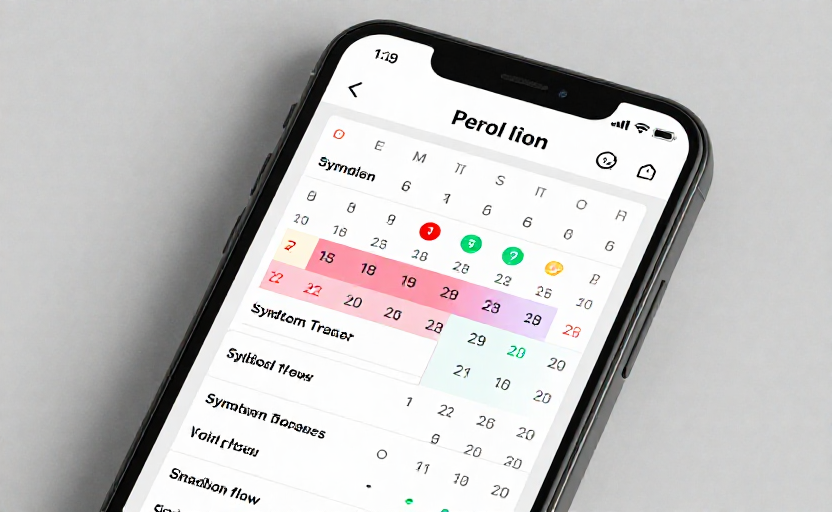
Your tracker can show more than just pain. If you regularly log heavy flow days that require changing a tampon or pad every 1-2 hours, or if your period stretches past seven days, this points to menorrhagia. Endometrial tissue can cause excessive menstrual bleeding, and your app’s flow-logging feature — on a scale from spotting to heavy — may reveal a pattern that you’ve normalized. Review your history: are you seeing “heavy” logged for 4+ days each cycle? That’s a pattern worth discussing.
4. You log pain with bowel movements or sex — but don't connect the dots
Period trackers that allow freeform notes or symptom tags can be the most revealing. If you’ve ever written down “sharp pain during bowel movements” around your period, or consistently tag “painful intercourse,” you have a data point that strongly correlates with endometriosis. Endometrial lesions often grow near the rectum, vagina, or uterosacral ligaments, making these activities painful. If your tracker history shows these tags recurring monthly — even if you initially thought they were unrelated — it is a powerful signal.
5. Your symptoms are causing “life interference” and you still don’t have a diagnosis
Not all patterns are numerical. If you look back at your log and see multiple months where you wrote “missed work,” “cancelled plans,” or “used heating pad all day,” you may have normalized a level of pain that is not normal. Endometriosis can cause fatigue, nausea, bloating (often called “endo belly”), and brain fog. When your tracker notes these alongside menstrual days, it reveals a pattern: your symptoms are consistently interfering with your life. That pattern alone — absence of diagnosis despite functional impairment — is a reason to seek a specialist opinion.
What to do with this information
Start by exporting or printing the last 3–6 months of your period tracker data. Look for patterns around pain timing, flow severity, and non-menstrual symptoms. Bring this summary — not just your app — to a gynecologist appointment. Ask explicitly: “Could these patterns fit endometriosis?” Laparoscopy remains the gold standard for diagnosis, but a thorough history supported by your tracker data can accelerate the process.