
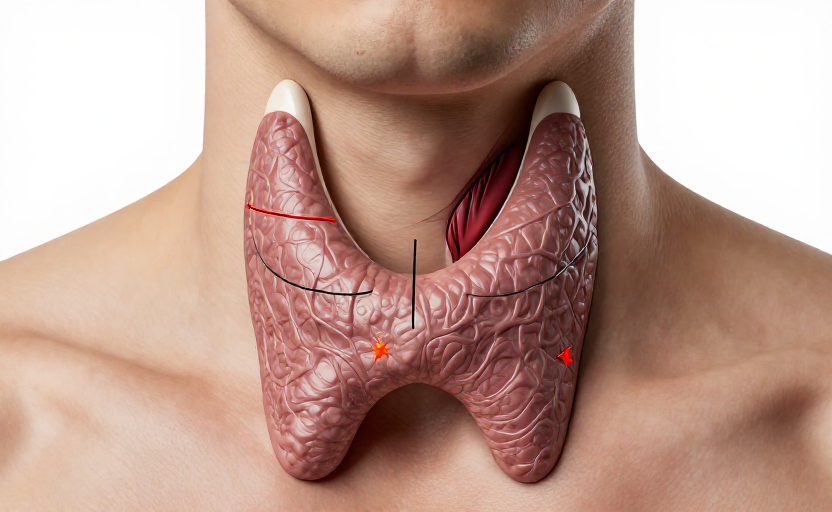
Deciding to have thyroid surgery is rarely straightforward. For many, the gland is quietly working—or not working—in the background until lab results or a physical finding pushes the conversation toward an operation. But when do you actually need to stop monitoring and start scheduling? According to endocrinologists, the decision is never based on a single symptom or a lab value alone. Instead, it is a combination of structural, functional, and safety factors that tip the scales.
Here are five warning signs that your thyroid condition may have progressed to a point where surgery—a thyroidectomy—is worth a serious discussion with your specialist. These signs are pulled directly from what endocrinologists look for in clinical practice, not from internet conjecture.
1. A Nodule or Goiter Is Causing Physical Compression
The thyroid sits right in front of your windpipe (trachea) and wraps around the esophagus. When it enlarges significantly—due to a goiter, a dominant nodule, or multiple nodules—it can start pressing on these structures. This is not always painful, but it is unmistakable once you notice it.
The warning sign: You feel like something is stuck in your throat (globus sensation), you have trouble swallowing solid foods, or you notice your voice is hoarse without a cold. Some people describe a feeling of choking when lying flat. If a large goiter compresses the trachea, you may also experience shortness of breath or a new, persistent cough.
Quick caveat: If you have a sudden, severe difficulty breathing or swallowing, call 911. That is a medical emergency, not a topic for a routine office visit.
Endocrinologists take this seriously because compression can worsen over time. If imaging shows the trachea is deviated or narrowed, surgery is often the only reliable way to open the airway and restore normal swallowing.
2. A Biopsy-Confirmed or Suspicious Thyroid Nodule
This is the most common reason for thyroid surgery in the United States. When a nodule is found—usually incidentally on a neck ultrasound or CT scan—your doctor may recommend a fine-needle aspiration (FNA) biopsy to check for cancer cells.
Results that signal surgery:
- Bethesda V or VI: Malignant or suspicious for malignancy. In these cases, a thyroid lobectomy or total thyroidectomy is the standard of care to remove the cancerous tissue and prevent spread.
- Bethesda III or IV: Atypia of undetermined significance or follicular neoplasm. These are gray zones. Surgery is not always urgent, but many endocrinologists will recommend at least a diagnostic lobectomy because about 20–30 percent of these nodules turn out to be malignant on final pathology.
- Nodules that grow rapidly (more than 2 mm per year in two dimensions) or develop concerning ultrasound features—such as microcalcifications, irregular margins, or taller-than-wide shape—are also red flags even if initial biopsy is benign.
This is not a "wait and see" situation if you have multiple suspicious features. Surgery in these cases removes the threat directly and gives you a definitive diagnosis.
3. Unmanageable Hyperthyroidism That Fails Medical Therapy
Hyperthyroidism (overactive thyroid) can often be managed with antithyroid medications like methimazole or with radioactive iodine ablation. However, for some patients, these treatments do not work well or cause significant side effects.
The warning sign: Your Graves' disease or toxic nodular goiter is causing rapid heart rate, severe anxiety, weight loss, or heat intolerance—and medication does not bring it under control. If you cannot take antithyroid drugs due to agranulocytosis (a dangerous drop in white blood cells) or liver injury, medical therapy is off the table. Similarly, some patients have severe ophthalmopathy (eye disease) that can worsen with radioactive iodine.
In these scenarios, thyroidectomy offers a definitive cure. Once the thyroid is removed, your overactive thyroid hormone production stops. You will need lifelong thyroid hormone replacement (levothyroxine), but for many, the trade-off of trading a chronic, unstable condition for a predictable daily pill is worth it.
4. A Growing Goiter That Poses a Cosmetic or Functional Concern
Not all thyroid surgery is about cancer or emergency compression. Sometimes, a benign goiter grows large enough to make everyday life uncomfortable—even before it causes airway or swallowing problems.
The warning sign: Your neck looks visibly swollen or asymmetric, and it bothers you. You may feel a constant sense of fullness, have trouble buttoning your collar, or notice that your neck is getting larger despite normal thyroid function tests. Some patients report that they cannot comfortably wear turtlenecks or necklaces anymore.
Endocrinologists often call this the "quality of life" indicator. If a goiter is large (usually more than 40–50 grams on ultrasound) and still growing, it is unlikely to shrink on its own. Surgery is the only option to reduce the size.
This is a valid reason for surgery. If the goiter affects your ability to swallow, breathe, or sleep—or if it simply causes significant self-consciousness—a thyroidectomy can be both a medical and a quality-of-life solution.
5. Recurrent Thyroid Cyst or Nodule That Keeps Coming Back
Some thyroid nodules are not solid but cystic—fluid-filled sacs. These can be drained with a needle (aspiration) in the office, which often provides immediate relief if the cyst is large and uncomfortable. However, they frequently recur.
The warning sign: You have had the same nodule aspirated two or three times, and it fills back up within weeks or months. Alternatively, you have had a benign nodule that was treated with ethanol ablation (injection) and it has returned. In these cases, repeated procedures are not only annoying but also carry a small risk of infection, bleeding, or scarring inside the gland.
When a cystic nodule refuses to stay gone, surgery is a one-time fix. A lobectomy removes the cyst and the surrounding abnormal thyroid tissue, eliminating the structural problem entirely.
Important perspective from endocrinologists: Even if you have one or more of these warning signs, surgery is not an automatic yes. Your endocrinologist will consider your overall health, your thyroid function, your age, and your personal preferences. Thyroid surgery, while generally safe, carries risks including damage to the parathyroid glands (which control calcium) and the recurrent laryngeal nerve (which controls voice). A skilled surgeon—especially one who performs high-volume thyroid surgery—minimizes these risks significantly.
The bottom line: Do not wait until you are struggling to breathe or you feel a lump the size of a golf ball in your neck. If you have persistent swallowing trouble, a suspicious biopsy, a goiter that is growing, or uncontrolled hyperthyroidism, bring up the surgery conversation directly. Your endocrinologist is trained to help you weigh the risks and benefits. The goal is not to rush into an operating room—it is to keep you safe and comfortable for the long haul.