
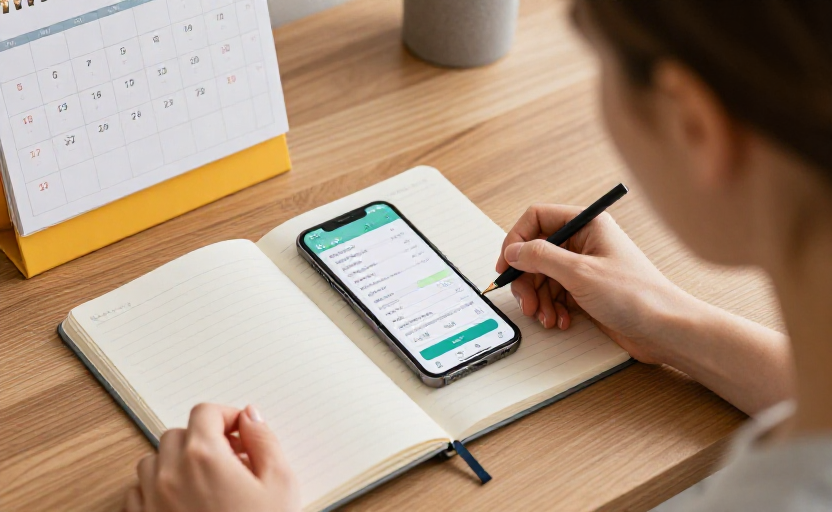
Tracking your menstrual flow at home can give you valuable insights into your cycle health, but small missteps in how you monitor can lead to inaccurate records or unnecessary worry. Whether you're using an app, a paper calendar, or a simple notebook, avoiding a few common errors will help you get the most reliable picture of what your body is doing.
Below are three mistakes people often make when tracking their period flow—along with practical fixes to help you stay consistent and informed.
1. Relying on memory instead of logging in real time
One of the most frequent slip-ups is waiting until the end of the day—or the end of the cycle—to jot down flow details. Memory is surprisingly unreliable when it comes to estimating how heavy or light a day was. You might remember Tuesday as "medium" when it actually started heavy and tapered by afternoon.
Instead, make a habit of noting your flow at the same time each day—ideally when you change your pad, tampon, cup, or disc. Many cycle trackers let you add a quick note in seconds. If you prefer paper, keep your log in the bathroom with a pen. Real-time tracking cuts down on guesswork and gives your healthcare provider much better data if you ever need to discuss irregularities.
2. Using vague or inconsistent descriptors
Another common mistake is using subjective words like "light," "medium," or "heavy" without a personal reference point. One person's "heavy" can look very different from another's. This makes it harder to spot changes across cycles or communicate clearly with a clinician.
A more reliable approach is to anchor your descriptions to something concrete. For example:
- Track how many pads, tampons, or menstrual cup empties you use per day. A typical saturated regular tampon holds about 5 milliliters of fluid; a super can hold more.
- Note whether you need to change protection every two hours versus every four to six hours.
- Record the presence of clots (size and number) and color changes (bright red vs. dark brown).
Using these measurable markers transforms vague terms into useful, consistent data. Over time, you'll have a clear baseline—and you'll notice sooner if something shifts.
3. Focusing only on flow and ignoring other cycle clues
Period flow is just one piece of the menstrual health puzzle. A mistake many trackers make is recording only the days and heaviness of bleeding, while skipping other signs that can reveal a lot about hormonal balance and overall wellness.
Consider noting these alongside your flow:
- Pain level (cramps, backaches, or headaches)
- Mood changes or energy dips
- Breast tenderness
- Digestive changes like bloating or constipation
- Sleep quality
When you connect the dots between flow patterns and these accompanying symptoms, you gain a fuller understanding of your cycle. For example, heavy flow with large clots combined with severe cramps could be a pattern worth discussing with a gynecologist. A consistently light period with spotting between cycles might flag a hormonal concern.
A quick tip: Most cycle-tracking apps allow custom tags or notes. Use them to build a complete log, not just a bleeding calendar.
When to share your tracking with a healthcare provider
Even the most accurate home tracking isn't a substitute for medical advice. If you notice any of the following, consider bringing your log to your next appointment:
- Cycles shorter than 21 days or longer than 35 days (if you're not using hormonal contraception that affects cycle length)
- Bleeding that soaks through a pad or tampon every hour for several hours in a row
- Flow that lasts more than seven days
- Large clots (bigger than a quarter) appearing regularly
- Bleeding between periods or after sex
- A sudden change from your usual pattern
A well-kept log with concrete details helps your doctor identify potential issues like uterine fibroids, endometriosis, polycystic ovary syndrome (PCOS), or thyroid disorders. It also helps rule out problems if everything looks normal.
Tracking your period flow at home can be a simple, powerful tool for self-awareness. Skip the three common mistakes above—logging from memory, using vague terms, and ignoring other symptoms—and you'll have data that actually helps you understand your cycle and communicate better with your healthcare team.