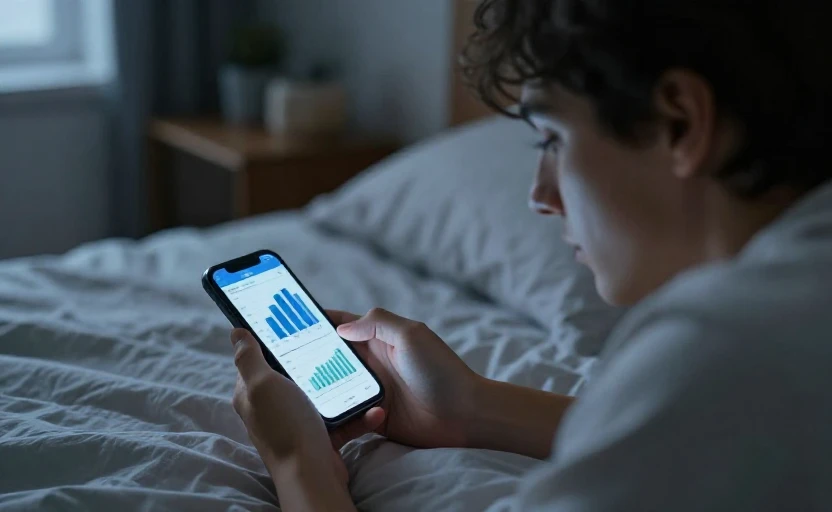
Your sleep tracker has become a nightly companion, quietly gathering data while you rest. But beyond the simple score or hours logged, this information holds a detailed story about your habits, your environment, and the subtle rhythms of your body. Learning to read this story isn't about chasing a perfect number; it's about connecting the dots between your daytime choices and your nighttime experience.
The graphs and percentages can feel abstract at first. What does it really mean if your heart rate variability dips, or your deep sleep is fragmented? By looking at patterns over time, you can move from simply observing data to understanding the context behind it. This turns raw numbers into actionable insights about your own unique sleep biology.
Beyond the sleep score: Key metrics explained
Most trackers provide a handful of core metrics. Sleep duration is the most straightforward, but consistency is often more telling than a single night's total. A pattern of wildly varying bedtimes and wake-up times, even if you clock eight hours, can disrupt your circadian rhythm, which your tracker may note as poor "sleep consistency."
Sleep stages—light, deep, and REM—paint a picture of your sleep architecture. It's normal for these to cycle throughout the night. Rather than fixating on one night's deep sleep percentage, look for trends. Do you get less deep sleep on nights after intense evening workouts? Does REM sleep, crucial for memory and mood, increase toward the morning and get cut short by an early alarm?
Restlessness or "time awake" is a critical clue. Frequent, brief awakenings you don't remember can point to environmental disruptions—a room that's too warm, a partner's snoring, or street noise. Your tracker is exceptionally good at spotting these disturbances you might otherwise miss.
Connecting daytime habits to nighttime data
This is where your tracker transforms from a reporter into a guide. The data reveals correlations, helping you see the impact of your daily routine.
Notice your sleep latency—the time it takes to fall asleep—spiking on certain nights? Look back at your day. A late, heavy meal, a stressful work conversation held too close to bedtime, or screen time right up until lights out can all lengthen this window. Your tracker can't identify the specific cause, but it can reliably show you the effect.
Similarly, observe your resting heart rate and heart rate variability (HRV). HRV, a measure of the variation in time between heartbeats, is a window into your nervous system. A higher HRV generally suggests better recovery and resilience. You might see it drop after a day of high stress, poor hydration, or excessive alcohol consumption, even if you slept a full eight hours. This data helps you connect lifestyle factors with your body's readiness for rest.
The most powerful insight often comes not from a single night's data, but from the pattern that emerges over a week or a month.
Evening routines under the microscope
Your pre-bed ritual leaves fingerprints on your sleep data. That evening glass of wine might help you fall asleep faster, but the tracker often reveals the second act: increased restlessness, a elevated heart rate during the night, and suppressed REM sleep in the later cycles. Conversely, a wind-down routine with dim lights and a quiet activity might correlate with a smoother descent into sleep and more stable deep sleep early in the night.
What your data isn't telling you (and the limits of tracking)
It's essential to approach this data with a calm perspective. Consumer sleep trackers are excellent at measuring movement and heart rate, but they are not medical-grade diagnostic tools. They infer sleep stages from these signals, which can sometimes lead to misclassification.
Don't let the pursuit of "perfect" data create its own source of anxiety, sometimes called "orthosomnia." If you find yourself losing sleep over your sleep scores, it's time to step back. The goal is improved feeling, not just improved metrics. Use the data as a guide for experimentation, not as an absolute verdict on your sleep quality.
Turning insights into action
Once you spot a pattern, you can test a change. If data shows frequent wake-ups at 3 a.m., consider if your room temperature peaks then. Try lowering the thermostat or using lighter bedding. If your deep sleep is consistently low on weekdays, experiment with shifting your intense exercise to the morning or afternoon and observe the results over several nights.
Focus on one variable at a time—like caffeine cutoff time or evening light exposure—and give it at least a week to see what the trend shows. This methodical approach helps you identify what genuinely moves the needle for you, personally.
- Review weekly, not nightly: Look for trends over time to smooth out the noise of one-off bad nights.
- Correlate, don't isolate: Always ask, "What was different about my day?" when you see an anomaly in your data.
- Prioritize consistency: A regular sleep schedule is one of the most powerful levers for improving almost every metric.
- Listen to your body: If you feel great but your score is mediocre, trust the feeling. The tracker is a tool, not the judge.
Your sleep tracker data is a conversation starter with your own physiology. By learning its language, you can uncover the subtle ways your habits shape your rest and make informed, gentle adjustments that support more restorative sleep, night after night.