
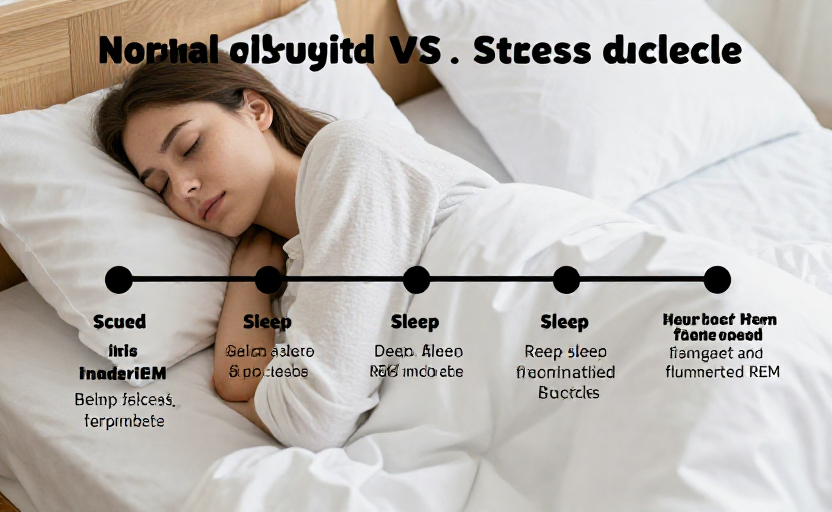
You know the feeling: you finally get into bed, your head hits the pillow, and your brain decides it is the perfect time to replay every awkward conversation from the last five years. Or perhaps you fall asleep quickly but wake up at 3 a.m. with a racing heart, unable to switch off. This isn't just "bad sleep" — it is a fundamental shift in your sleep architecture, driven by stress and anxiety.
Sleep architecture is simply the structure of your sleep: the cycling between light sleep, deep sleep, and REM (rapid eye movement) stages throughout the night. When stress hormones like cortisol are elevated, that delicate structure gets remodeled in ways that leave you less rested. Understanding the mechanics of this change is the first step toward reclaiming your nights.
How Stress and Anxiety Reshape Your Sleep Cycle
Under normal conditions, your body follows a predictable rhythm. You drift through light sleep, descend into restorative deep sleep, and then spend significant time in REM — the stage where emotional processing and memory consolidation happen. You repeat this cycle roughly every 90 minutes.
When your nervous system is caught in a stress response, two key things happen:
- Your deep sleep gets compressed. High cortisol levels make it harder to enter and maintain slow-wave sleep (the deepest, most restorative stage). You spend less time here, so your body does less physical repair and immune maintenance.
- Your REM sleep becomes fragmented. Instead of long, stable REM periods, you may experience more frequent awakenings or jump straight into lighter sleep stages. This disrupts emotional regulation, leaving you more reactive and anxious during the day.
Think of it this way: stress creates a lighter, more brittle sleep structure — one that breaks apart easily at the slightest disturbance.
The result is a feedback loop. Poor sleep makes you more vulnerable to stress, and higher stress further degrades your sleep architecture. Breaking that loop requires targeting the architecture itself, not just the surface symptoms.
The Chemical Players: Cortisol, Adrenaline, and GABA
Your sleep architecture is governed by a delicate chemical balance. Stress and anxiety tip the scales in predictable ways:
- Cortisol — normally low at night and high in the morning. Chronic stress keeps nighttime cortisol elevated, which directly suppresses deep sleep and shifts you toward lighter stages.
- Adrenaline and noradrenaline — these fight-or-flight chemicals keep your brain slightly on alert even during sleep, making it harder to achieve the neural synchrony needed for deep rest.
- GABA — your brain's main inhibitory neurotransmitter, which helps calm neural activity. Chronic anxiety can reduce GABA sensitivity, making it harder for your brain to "shut down" for sleep.
This is why willpower alone rarely fixes stress-related insomnia — you are working against a physiological shift in your brain's operating system.
What Changes in Each Sleep Stage
Light Sleep (N1 and N2)
Under stress, you may spend more total time in light sleep, but it becomes inefficient. You are more likely to have micro-awakenings (brief moments of consciousness you don't fully remember) and greater sensitivity to environmental noises. Your sleep feels shallow and unsatisfying.
Deep Sleep (N3)
This is the stage most vulnerable to stress. Even moderate daily anxiety can reduce slow-wave sleep by 20 to 30 percent. Morning cortisol spikes (which can occur as early as 2 a.m. in stressed individuals) can abruptly pull you out of deep sleep, leading to that dreaded early-morning wakefulness.
REM Sleep
REM sleep becomes shorter and more fragmented. Because REM is critical for processing the emotional charge of memories, reduced REM means you carry yesterday's anxieties into today. This explains why a bad night's sleep often leaves you emotionally raw and less able to handle challenges.
Practical Steps to Protect Your Sleep Architecture
The goal is not to eliminate stress (that is not realistic). The goal is to stop stress from reshaping your sleep structure. These approaches work with your biology, not against it.
- Anchor your morning light exposure. Viewing natural light within 30 minutes of waking helps set a strong circadian rhythm and improves your body's ability to time cortisol release correctly. This single habit can improve deep sleep quality in as little as one week.
- Create a 90-minute "buffer zone" before bed. Spend the last 90 minutes of your day doing low-stimulation activities. Avoid screens, intense conversations, or work-related thinking. Instead, try reading (physical book), gentle stretching, or listening to calm music. This allows your stress hormones to begin their natural decline.
- Use temperature to signal deep sleep. Your core body temperature needs to drop for deep sleep to occur. Keep your bedroom cool (65–68°F / 18–20°C) and avoid heavy blankets that trap heat. A warm bath or shower 90 minutes before bed helps trigger the temperature drop that follows.
- Practice "scheduled worry time". Set aside 10 to 15 minutes in the late afternoon to actively write down your worries and possible solutions. If anxious thoughts arise at night, remind yourself they already have a designated time and place. This containment approach reduces the cognitive arousal that fragments REM sleep.
- Limit alcohol within three hours of bedtime. Alcohol is notorious for suppressing REM sleep and disrupting deep sleep architecture. Even one drink can reduce REM by 20 to 30 percent for that night. If you do drink, keep it earlier in the evening and hydrate well.
A note on supplements and medications: Some people find magnesium glycinate or L-theanine helpful for supporting relaxation, but individual responses vary. Never combine sleep aids without consulting a healthcare professional. This article does not replace personalized medical advice.
A Quick Overview for Your Nightly Routine
- Deep sleep boosters: Morning light, cool room temperature, consistent bedtime
- REM sleep protectors: Scheduled worry time, no alcohol before bed, avoiding late meals
- General architecture support: Limited caffeine after noon, regular exercise (completed at least three hours before bed), consistent wake-up time even on weekends
When to Seek Professional Help
If you have consistently poor sleep for more than three weeks despite making these adjustments, it is worth discussing with a doctor or a sleep specialist. Chronic stress that has reshaped your sleep architecture may require additional support — such as cognitive behavioral therapy for insomnia (CBT-I) or targeted anxiety management. Sleep architecture can heal, but sometimes it needs more than home adjustments.
Restoring your sleep structure is a gradual process. Your body remembers how to sleep well — you just need to clear the obstacles stress has placed in its way.