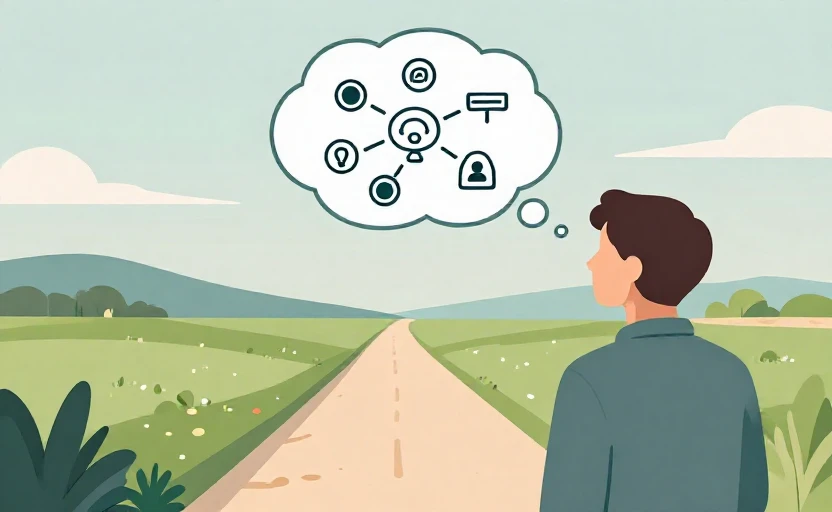
Anxiety doesn't arrive out of nowhere. It often follows a pattern, a reaction to specific thoughts, situations, or memories that act as a catalyst. These are your anxiety triggers—the unique, often subtle cues that can shift your day from calm to overwhelming. Understanding them isn't about assigning blame or weakness; it's about gaining a powerful form of self-knowledge. When you can identify what sparks your anxiety, you move from being a passive passenger to an active navigator of your own emotional landscape.
This guide walks you through that process of discovery and offers practical, grounded strategies for managing the triggers you uncover. It’s a map for moving from reaction to response.
What exactly is an anxiety trigger?
Think of a trigger as a mental shortcut, a signal your brain has learned to associate with threat or distress. It can be external—a crowded room, a critical comment, a specific time of year—or internal, like a racing heart, a particular memory, or a cascade of “what-if” thoughts. The trigger itself isn't the anxiety; it's the match that lights the fuse. Your nervous system then reacts, often with a fight, flight, or freeze response that feels automatic and intense.
The goal isn't to eliminate all triggers, which is often impossible, but to change your relationship to them.
How to identify your personal triggers
Pinpointing your triggers requires becoming a gentle detective of your own experience. This isn't about judgment, but observation. Start by keeping a simple log for a week or two. After a moment of heightened anxiety, pause and note a few things: Where were you? What was happening just before you felt the shift? What were you thinking about? Who was around? What physical sensations did you notice first?
Look for patterns. You might see that anxiety spikes consistently:
- After scrolling through social media
- In the hour before a weekly meeting
- During conversations about finances
- When you feel physically tired or hungry
- In environments with loud, chaotic noise
Common categories of triggers include stress from work or relationships, health concerns, world events, substances like caffeine or alcohol, and even reminders of past traumatic experiences. The key is that your set is personal. What unsettles one person might be neutral for another.
Practical strategies for managing triggers
Once you have a clearer picture of your triggers, you can build a toolkit to manage their impact. These strategies work by creating space between the trigger and your reaction, giving your nervous system a chance to settle.
In the moment: Grounding techniques
When a trigger strikes and anxiety surges, your brain is in alarm mode. Grounding techniques help bring your awareness back to the present, physical world. Try the 5-4-3-2-1 method: Name five things you can see, four you can touch, three you can hear, two you can smell, and one you can taste. Alternatively, focus on your breath. Don't try to change it at first; just notice the sensation of air moving in and out. These simple acts can interrupt the anxiety cycle.
Building long-term resilience
Daily habits form the foundation that makes triggers less potent. Consistent, moderate exercise is one of the most effective anti-anxiety practices, helping to regulate stress hormones. Prioritizing sleep is non-negotiable; fatigue lowers your threshold for stress. Mindfulness or meditation, even for a few minutes a day, trains your brain to observe thoughts and sensations without being swept away by them.
Also, examine your information diet. Constant exposure to news or social media can be a significant, chronic trigger for many. Setting boundaries around consumption can create a more peaceful mental environment.
When avoidance becomes the problem
It's natural to want to avoid what makes us anxious. In the short term, it works—you skip the party and your anxiety drops. But over time, avoidance teaches your brain that the trigger is indeed dangerous and must always be avoided, shrinking your world and reinforcing the anxiety.
The healthier approach is gradual exposure. If small talk triggers social anxiety, you don't start by giving a speech. You might begin by simply making brief eye contact and smiling at a cashier, then work up to asking a coworker a question. Each small, managed step, taken without the feared outcome occurring, rewires the associative learning.
Knowing when to seek support
While self-management is powerful, some triggers, especially those rooted in deep trauma or that lead to debilitating panic, require professional guidance. A therapist can help you safely process the roots of a trigger and develop tailored coping strategies. Consider seeking support if your triggers significantly impair your work, relationships, or daily functioning, or if your coping mechanisms are harmful (like substance use).
Understanding and managing anxiety triggers is a continuous practice of self-compassion and skill-building. It’s about learning your own rhythms, respecting your sensitivities, and gently expanding your capacity to meet life's inevitable challenges. You are not erasing your anxiety; you are learning to live with more agency and peace alongside it.