Choosing the right food for your baby is one of the most tangible ways to nurture their health. It’s also a task that can feel surprisingly complex, especially when you’re standing in the grocery aisle, turning over jar after pouch, trying to decipher the tiny print on the label. Terms like “naturally sweetened” or “no added salt” can sound reassuring, but the full story is often in the details of the ingredients list and nutrition facts panel. Learning to read these labels isn’t about perfection—it’s about empowerment. With a few key pointers, you can confidently navigate the options and make informed choices that support your baby’s developing taste for wholesome, simple foods.
The goal isn’t to eliminate every gram of sugar or sodium; both occur naturally in healthy foods like fruits and vegetables. The focus, instead, is on identifying added sugars and excess sodium that don’t contribute nutritional value. Early exposure to very sweet or salty flavors can shape long-term preferences, making it harder for little ones to appreciate the subtle tastes of whole foods. By becoming a savvy label reader, you’re not just picking a product for today; you’re helping to cultivate your child’s palate for a lifetime of healthier eating habits.
Start with the ingredients list
This is the most important place to look. Ingredients are listed in descending order by weight, so what’s first makes up the largest proportion of the food. For a simple purée, you ideally want to see a single fruit or vegetable, or a short, recognizable list.
Be on the lookout for added sugars, which can appear under many names. Common ones in baby food include:
- Fruit juice concentrate (e.g., pear, apple, grape)
- Syrups like corn syrup, malt syrup, or rice syrup
- Words ending in “-ose” like sucrose, fructose, glucose, maltose, or dextrose
- Evaporated cane juice
- Honey (which should be avoided entirely for babies under one year due to botulism risk)
A simple rule: if a savory vegetable purée lists any form of sugar or juice concentrate in the first three ingredients, it’s likely been sweetened more than necessary.
Decode the nutrition facts panel
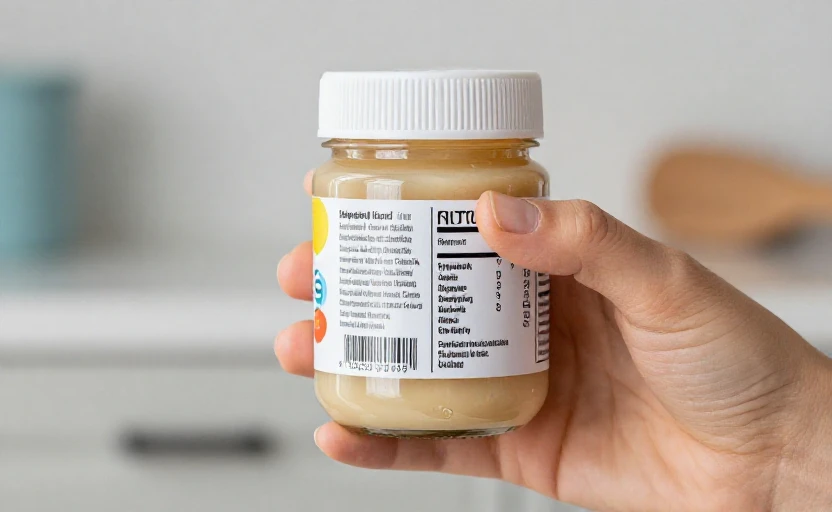
While the ingredients list tells you what’s in the food, the Nutrition Facts panel tells you how much. For baby food, pay closest attention to two lines: “Total Sugars” and “Sodium.”
For sugars, note the amount in grams. There’s no official daily limit for infants, but for context, 4 grams of sugar is about 1 teaspoon. A purée containing only fruit will have natural sugars, which is fine. The concern is when sugars are added to foods that don’t need them, like carrots or peas. Compare similar products—the one with lower total sugar is often the simpler choice.
For sodium, look at the milligrams (mg) per serving. Babies under 12 months need less than 370 mg per day, according to most pediatric guidelines. A single serving of baby food should be very low. A good benchmark is to seek out savory items with less than 50 mg of sodium per jar or pouch, and ideally closer to 20 mg or less.
Understand common marketing claims
Front-of-package claims are designed to catch your eye, but they have specific meanings regulated by food authorities.
- “No Added Sugar” or “No Added Salt”: This means the manufacturer did not add sugar or salt during processing. The food may still contain natural sugars (like from fruit) or naturally occurring sodium.
- “Organic”: This certifies how the ingredients were farmed (without synthetic pesticides, etc.), but it says nothing about the sugar or salt content. An organic apple purée is a great choice, but an organic “banana dessert” with added sugar is still a sweetened product.
- “Naturally Sweetened”: This is a phrase to scrutinize. It usually means the sweetness comes from a concentrated source like fruit juice, not refined sugar. While technically “natural,” it’s still a form of added sugar that can raise the total sugar content significantly.
Practical tips for the grocery aisle
Armed with this knowledge, your shopping trips can become more straightforward. Start by picking up the product and immediately turning it over. Glance at the ingredients list length and order—shorter is generally better. Then, check the “Total Sugars” and “Sodium” on the nutrition panel. For everyday purées, choose options where the first ingredient is the fruit or vegetable itself, with no added sweeteners and minimal sodium.
Remember, you are the expert on your child. Sometimes, a fruit blend with a touch of lemon juice concentrate (for freshness) is a fine occasional choice. The aim is to build an overall pattern of choosing foods with simple, whole-food ingredients. When you prioritize these foods, you’re giving your baby a foundation that celebrates the true, gentle flavors of wholesome ingredients.