You wake up, glance at your sleep tracker, and see a colorful chart breaking down your night into light, deep, and REM sleep. The numbers are there—percentages, durations, a timeline—but what do they actually mean for how you feel? Interpreting sleep stage data can feel like decoding a foreign language, leaving you wondering if a "good" score is just a number or a genuine reflection of rest.
This data, gathered from wearables and bedside devices, offers a fascinating window into the architecture of your night. It’s not about achieving perfect scores every single time, but about understanding the natural rhythm of sleep and spotting meaningful trends over days and weeks. Let’s translate those graphs into practical insights you can use.
What Are Sleep Stages, Really?
Sleep isn’t a uniform state of unconsciousness. It’s a dynamic, cyclical process with distinct phases, each serving a unique purpose for physical restoration, memory consolidation, and emotional processing. Modern trackers use sensors like accelerometers and heart rate monitors to estimate your movement and physiological changes, which correlate with these stages.
The classic model divides sleep into four stages, though many consumer devices group them into three or four categories for simplicity: light sleep, deep sleep, REM (Rapid Eye Movement) sleep, and sometimes "awake" periods.
Light Sleep (Stages N1 & N2)
This is your entry point into sleep and where you’ll spend about 50-60% of your night. It’s a transitional phase where your body begins to slow down—heart rate and breathing become regular, body temperature drops, and you become disengaged from your surroundings. It’s relatively easy to be woken from light sleep. Think of it as your brain’s filing system, where it sorts and processes the day’s information.
Deep Sleep (Stage N3)
Often called "slow-wave sleep," this is the most restorative phase. It’s when tissue growth and repair occur, energy is restored, and crucial hormones for growth and development are released. Your body is least responsive to external stimuli here. You typically get most of your deep sleep in the first half of the night. Waking from this stage often leaves you feeling groggy.
REM Sleep
This is the stage most associated with vivid dreams. Your brain becomes highly active—similar to wakefulness—while your voluntary muscles are temporarily paralyzed (a state called atonia). REM is critical for learning, memory consolidation, and mood regulation. REM periods become longer as the night progresses, with the longest stretches often occurring in the final hours before you wake.
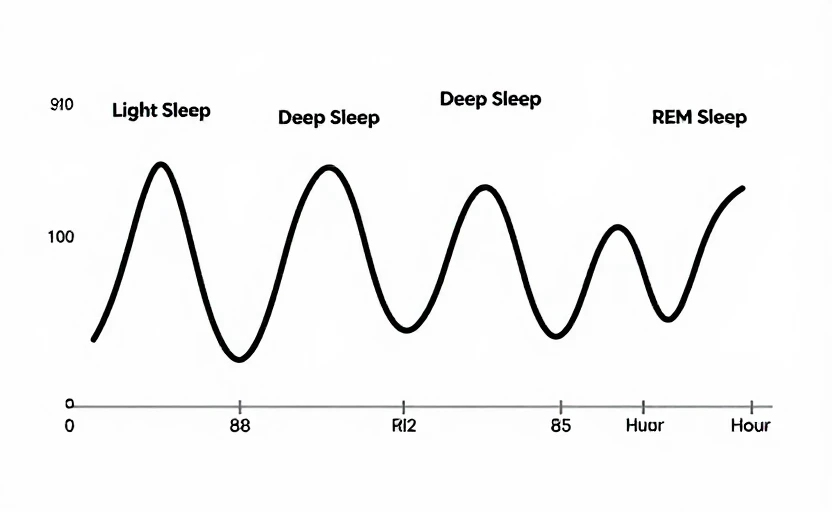
Your sleep cycles through these stages roughly every 90 minutes, repeating several times a night. A healthy pattern shows a rhythmic wave between light, deep, and REM.
How to Read Your Sleep Data Without Obsessing
The most important principle is to look at trends, not nightly absolutes. A single "bad" night according to your tracker is not a cause for alarm. Stress, a late meal, or a change in routine can all shift your stages temporarily. The real value emerges over a week or two of data.
Instead of fixating on hitting exact percentage targets, ask yourself these questions when you review your data:
- Is there a rhythm? Does your chart show a clear, repeating pattern of peaks (deep/REM) and valleys (light) throughout the night? A relatively smooth, wave-like pattern is a good sign of consolidated sleep.
- How does the data match your feeling? This is the most crucial correlation. Do you feel refreshed on days your tracker shows ample deep and REM sleep? Do you feel foggy when it shows frequent awakenings or very little deep sleep? Your subjective feeling is the ultimate metric.
- What’s the trend over time? Use the weekly or monthly view. Are you gradually getting more or less deep sleep? Is your time to fall asleep increasing? Trends can help you connect the dots to lifestyle factors.
Common Data Patterns and What They Might Suggest
Certain patterns in your sleep stage data can be clues, though they are not diagnoses. They are starting points for observation.
Minimal or Fragmented Deep Sleep: If your data consistently shows very short or broken periods of deep sleep, consider factors that might be preventing your body from fully settling into its most restorative state. High stress, consuming alcohol close to bedtime, sleeping in a hot or uncomfortable environment, or even intense late-evening exercise can interfere with deep sleep quality.
Delayed or Reduced REM Sleep: REM sleep can be suppressed by substances like alcohol and certain medications. It’s also often the stage that gets "short-changed" when you don’t get enough total sleep, as you cut off those longer REM periods at the end of the night. Consistently low REM might align with feelings of brain fog or emotional irritability.
Frequent Awakenings (shown as spikes or gaps): The tracker notes you as "awake" even if you don’t remember it. Many brief awakenings are normal, but a pattern of longer or frequent disruptions can point to issues like sleep apnea, pain, an uncomfortable sleep environment, or even the need to limit fluids before bed.
The Limits of Consumer Sleep Trackers
It’s vital to maintain a healthy perspective on the data’s accuracy. Consumer devices provide estimates, not medical-grade measurements. They infer sleep stages from movement and heart rate variability, whereas a clinical polysomnogram (sleep study) measures brain waves, eye movements, and muscle activity directly.
This means your tracker might sometimes mislabel stages. For example, lying very still in bed while awake might be read as light sleep. The absolute numbers are less reliable than the relative patterns they show over time. Use the data as a guide for self-awareness and tracking trends, not as a definitive medical assessment.
If your data consistently shows extreme deviations (like virtually no deep sleep or excessive awakenings) and you experience significant daytime sleepiness or other symptoms, that’s a valid reason to discuss your observations—and your feelings—with a healthcare provider.
Using Your Data to Support Better Sleep
The goal isn’t to manipulate your stages directly, but to create conditions where healthy sleep architecture can naturally emerge.
- Protect Your Sleep Duration: Since REM sleep lengthens later in the night, consistently cutting your sleep short directly reduces your REM time. Prioritizing a full 7-9 hours is the single best way to ensure you cycle through all stages adequately.
- Observe Lifestyle Links: Use your tracker’s notes or journal feature. Note nights after you had alcohol, were highly stressed, or exercised late. See how those notes correlate with your deep and REM sleep percentages the next morning. This can reveal powerful personal triggers.
- Wind Down Effectively: A calm transition to bed supports the onset of sleep and the progression into deep sleep. A consistent, screen-free bedtime routine signals to your nervous system that it’s time to descend through the stages smoothly.
- Optimize Your Environment: A cool, dark, and quiet room is less likely to cause awakenings that fragment your deep and REM stages. This helps maintain the integrity of your natural sleep cycles.
Ultimately, your sleep stage data is a conversation with your own body. It’s a tool for curiosity, not for judgment. By learning its language—focusing on rhythms, correlations with how you feel, and long-term trends—you can move beyond anxiety over numbers and toward a more informed and supportive relationship with your sleep.