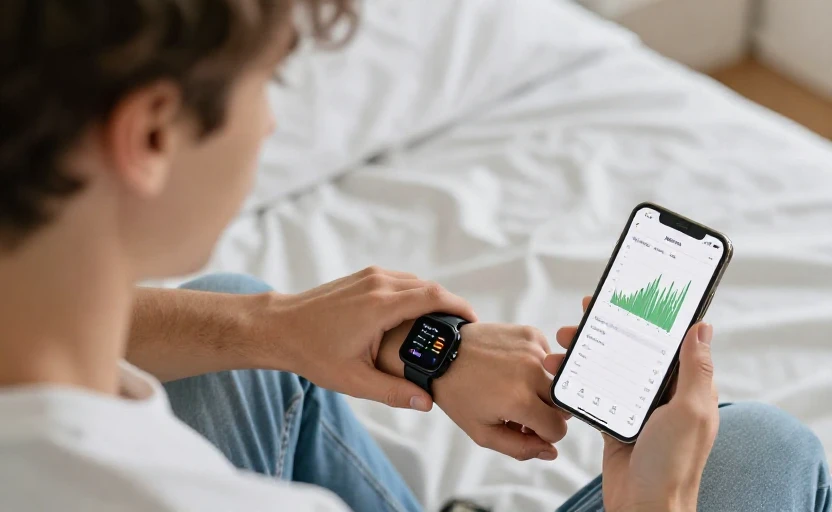
You wake up feeling surprisingly refreshed, only for your sleep tracker to declare you had a "poor" night with low deep sleep. Or perhaps the data shows you were "awake" for 45 minutes you have no memory of. This disconnect between how you feel and what your device reports is a common frustration. Sleep trackers, from wrist-worn wearables to under-mattress pads, are powerful tools for spotting trends, but they are not infallible clinical instruments. The data can be skewed by a variety of factors, leading to confusion or unnecessary anxiety about your sleep. Understanding these common causes of inaccuracy is the first step toward getting more reliable insights and using your tracker as the helpful guide it's meant to be.
Let's explore the typical reasons your sleep data might be telling a misleading story, and what you can do to get a clearer picture of your nightly rest.
1. Incorrect Wear and Placement
The most straightforward issue is often how and where you wear the device. For optical heart-rate sensors on wrist-worn trackers, placement is critical. A band that's too loose can allow the sensor to lift off your skin, creating gaps that interrupt data collection. A band that's excessively tight can restrict blood flow, which also distorts the heart-rate signal the device uses to infer sleep stages.
The position on your wrist matters, too. Most manufacturers recommend wearing the device about a finger's width above your wrist bone. Wearing it too high on the forearm or too low on the hand can place the sensor over tendons and bones instead of the capillaries it needs to monitor.
For the most consistent data, put your tracker on the same wrist, in the same position, every night. Check the fit: snug enough not to slide, but loose enough that you can fit a fingertip underneath.
2. Excessive Movement During Sleep
Sleep trackers rely heavily on movement (actigraphy) and heart rate variability (HRV) to distinguish between light sleep, deep sleep, and REM sleep. A night with lots of tossing and turning—whether from discomfort, a restless partner, or simply a different sleep position—can confuse the algorithm.
For instance, lying very still while awake (reading a book, trying to fall asleep) can sometimes be misread as light sleep. Conversely, a period of deep sleep that happens to coincide with more physical movement might be logged as light sleep or even awake time. This is a known limitation of consumer-grade trackers compared to the polysomnography used in sleep labs, which measures brain waves directly.
If you know you had an unusually restless night, take the stage breakdown with an extra grain of salt. Look at the broader trend over weeks, not the absolute numbers of a single night.
3. Low Battery or Sync Issues
Technology has its own needs. A device with a critically low battery may enter a power-saving mode that reduces how frequently it samples your heart rate or movement, leading to gaps in data or less precise stage detection. It's a good habit to charge your tracker as part of your evening routine, perhaps while you wind down before bed.
Sync failures can also create problems. If your device stores data locally but fails to sync with its companion app, you might see an incomplete or missing sleep log. Regular syncing ensures the full data set is available for the app's algorithms to process. Before assuming a night's data is accurate, confirm the device was charged and the data synced completely.
4. Lifestyle Factors Affecting Physiology
Your body's signals are the raw material for your tracker's analysis, and many lifestyle factors can alter those signals. Alcohol consumption, even in moderate amounts, is a classic confounder. It may help you fall asleep faster, but it typically suppresses REM sleep early in the night and can lead to more fragmented sleep later. This disruption changes your heart rate and movement patterns in ways the tracker may interpret erratically.
Similarly, intense evening workouts, high stress, caffeine consumption later in the day, or even a large meal before bed can elevate your resting heart rate. Since sleep trackers often use a drop in heart rate as a key marker for sleep onset and deep sleep, an elevated baseline can throw off the timing and classification of your sleep stages. The tracker isn't "wrong" per se—it's accurately recording an altered physiological state—but the resulting sleep score may not reflect your typical pattern.
Notice a strange sleep graph? Consider what you ate, drank, or did in the hours before bed. Context is key to interpretation.
5. Over-reliance on (or Misunderstanding of) Sleep Scores
This is less a technical glitch and more a human-factor issue. Many apps generate a simplified "sleep score"—a single number meant to summarize your night. While convenient, this score is a proprietary algorithm's interpretation of your data. It often heavily weights total sleep time and consistency of sleep schedule. You might feel great with 7 hours of solid sleep, but if the algorithm "prefers" 8 hours, your score may be unfairly low.
Focusing obsessively on achieving a perfect score or maximizing deep sleep can create performance anxiety around sleep, which is counterproductive. The real value of a tracker lies in observing trends: Are you consistently going to bed after midnight? Do your sleep graphs look more fragmented on nights you have alcohol? Does your resting heart rate trend upward during periods of high stress?
Use the data as a mirror, not a judge. Your subjective feeling upon waking—the sense of being restored or not—remains a profoundly important data point that no device can measure.
How to Get More Accurate and Useful Data
Improving your tracker's accuracy is about creating consistency and adding context.
First, establish a routine. Wear the device consistently on your non-dominant wrist, ensure a proper fit, and charge it regularly. Use the app's bedtime scheduling feature if it has one, as manually telling the device when you're going to sleep can improve onset detection.
Second, become a contextual observer. Most apps have a notes or tagging feature. Use it. Jot down "late dinner," "evening workout," "stressed about work," or "drank wine." Over time, you'll be able to cross-reference these notes with your data to see real-life cause and effect, which is far more valuable than any single night's score.
Finally, calibrate your device with your own experience. If you consistently wake up feeling good but your tracker says your sleep was poor, it's worth questioning the tracker's parameters, not your own perception. The goal is to support your well-being, not to serve a piece of technology.
Sleep trackers offer fascinating glimpses into our nightly patterns, but they are guides, not oracles. By understanding their limitations—from placement and movement to the influence of lifestyle on our body's signals—you can move past frustration with individual data points. You can start to see the broader story they tell about your habits and their impact on your rest. The most accurate measure of good sleep will always be how you feel during the day: energized, focused, and emotionally steady. Let your tracker inform that journey, not define it.